
PD Dr. med. Staab in an interview about AGNES and Nia
Digitalisation and digital tools are playing an ever larger role in medical care. PD Dr. Doris Staab, Berlin, a member of the Nia app's scientific advisory board and a board member of the Arbeitsgemeinschaft Neurodermitisschulung (German working group for eczema education), talks about how far this change also affects patient education and what benefits it can bring.
This year's AGAS/AGNES conference was also marked by a spirit of new beginnings and digitalisation. What influence does this change have on patient education?
Like many other areas, digitalisation has overtaken us. Because of the pandemic, we thought about how we could offer patient education in digital form, because the topic suddenly became very urgent. The pandemic has made health insurers more flexible about online events. So it was relatively unbureaucratic to run the courses online for pandemic-related reasons. Without the pandemic, that certainly would not have been so straightforward.
But online patient education has been a current topic for us for quite a long time. Our problem is that there are quite a lot of programmes in urban areas, while the situation in the countryside looks very different. In many parts of Germany, it is difficult for families with children who have eczema to access education programmes at all. That is why, at the AGAS/AGNES conference before last, we already called for new concepts to be developed that could close this gap in care.
What importance and what prospects does digitalisation have or offer in paediatric dermatology?
There are several aspects to consider. For dermatology, for example, I still find online consultations difficult – especially when it comes to the first appointment. With the skin in particular, it is not just looking but also touching that helps you with the diagnosis. Nevertheless, I believe that it certainly makes sense for ongoing management, as support for families who have no access to a specialist.
As far as education is concerned, I think there will be both kinds of programme side by side in the future. For me personally, the live group session is still the gold standard and the online version is the second-best option. But it is definitely better than nothing at all. That is why we at the Förderkreis Patientenschulung in Berlin were very hesitant about online programmes at first. In the meantime, however, we have found that this works very well both for anaphylaxis education and for eczema education – especially for parent education.
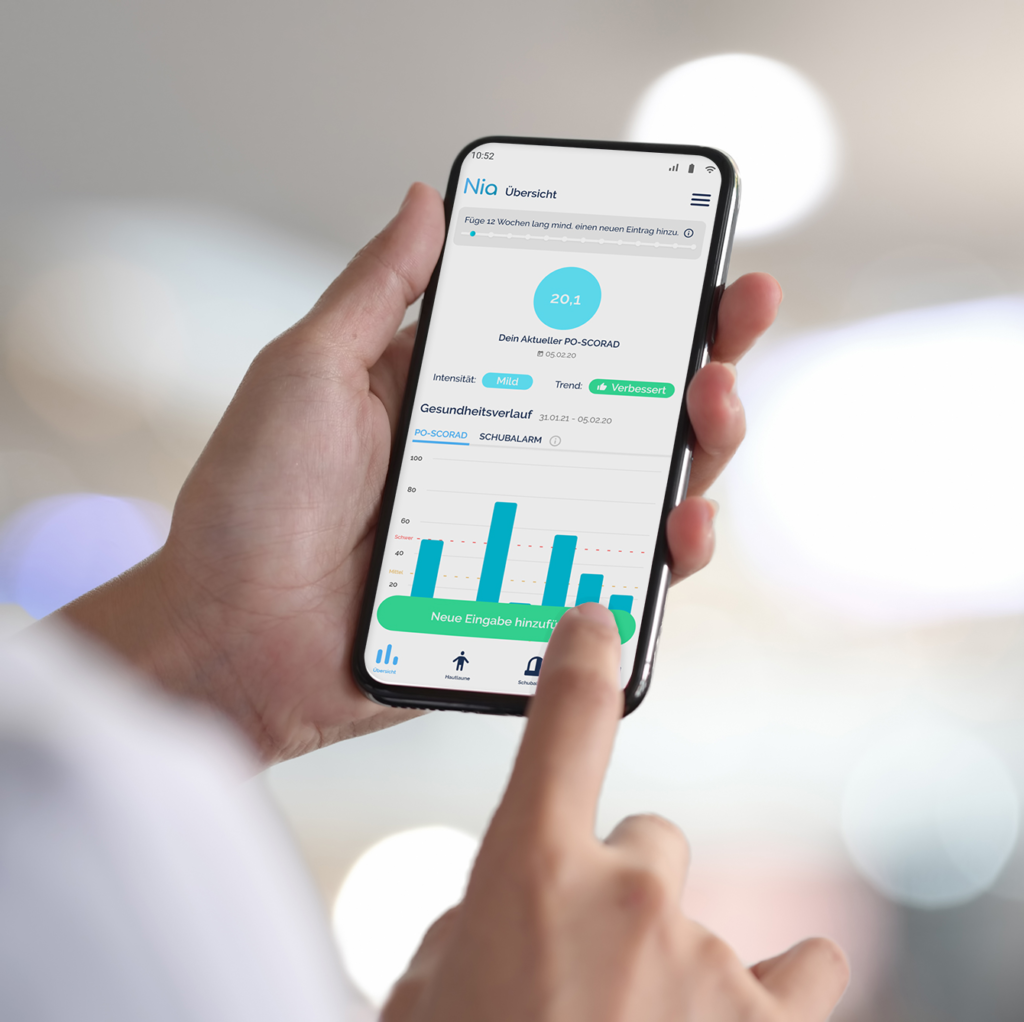
“The Nia app, on the other hand, is an excellent tool with a very good concept, because it was developed from the very beginning together with patients, parents and us specialists.”
Paediatricians and patients have more and more digital tools at their disposal, including the Nia app. How do you see the near future here?
Very good, actually, I have to say. Of course, the internet offers a huge range of options when you search for eczema. Among them are a number of non-validated offerings. The Nia app, on the other hand, is an excellent tool with a very good concept, because it was developed from the very beginning together with patients, parents and us specialists. Alongside the features that patients wanted, such as documenting the course of the condition, the Nia app also contains a range of validated educational content from the AGNES education programme. As AGNES, we have a cooperation with Nia that makes it possible to use the educational content digitally. In addition, patients who have taken part in our education programme are given free access to the Nia app. I think the two complement each other perfectly.
What is the aim of patient education?
The point and purpose of patient education is empowerment. It means enabling patients to make their own decisions, e.g. about the intensity of skin treatment – or, with children, of course, enabling the parents. It is about gaining a little more self-confidence in dealing with the condition. Parents and patients should be trained to trust the measures they use and not keep trying new things because new hyped products come onto the market. You should be able to tell reputable offerings from dubious ones. The Nia app can support this pretty well, because it takes up the topic of self-monitoring. It also addresses psychological topics, such as “what do I do about sleep problems” or “how can I recharge my batteries”, in other words everything that is also discussed in our education groups. This includes mini-videos on nutrition, among other things – because nutrition is a topic of uncertainty in eczema. Many people assume that certain foods are often to blame, but for the majority of children that is not the case. I think the Nia app covers these topics well. The developers have gone to great lengths to include only content in the app that is also medically validated.
The interview was conducted by Romina Maccioni of signum [ pr on behalf of L’Oréal.