
The importance and principles of regular skin care

What you’ll have learnt from this article
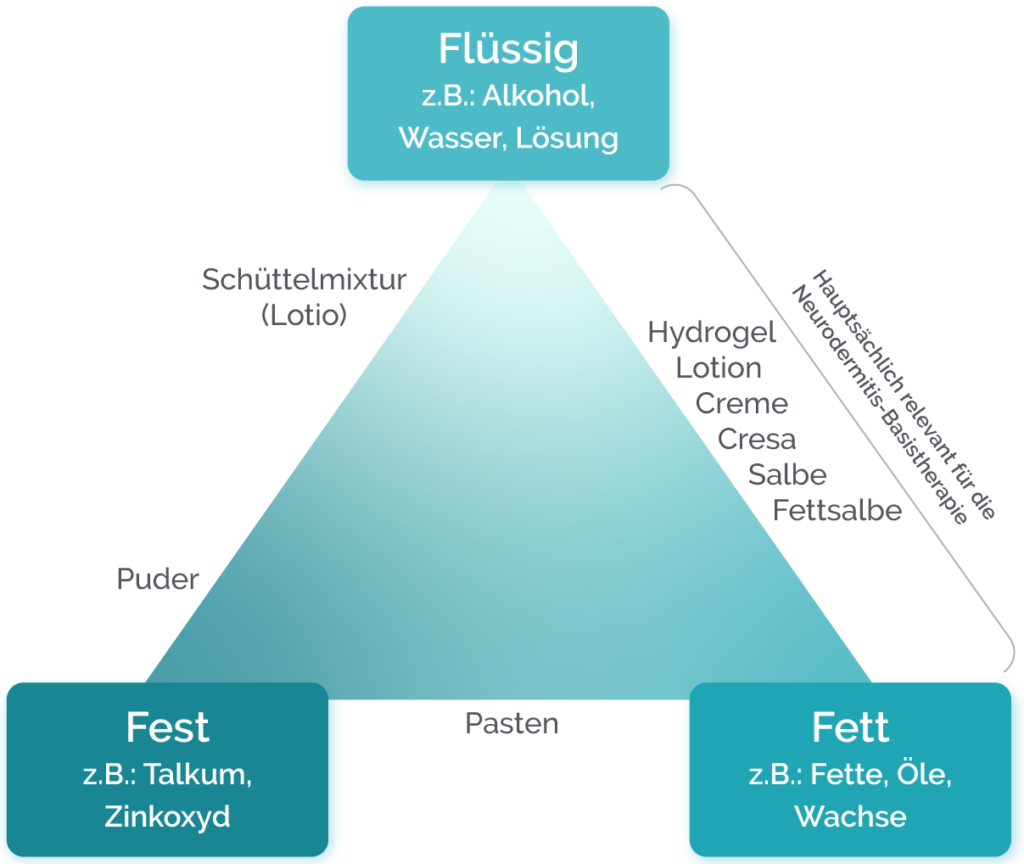
The following article explains the particular importance of basic therapy (i.e. skin care products) for strengthening the skin barrier. Basic therapy should always be guided by the current condition of the skin, the child’s age, the time of day and season, and the location of the eczema. The so-called phase triangle of dermatological topical therapy offers a helpful guide when selecting the right basic therapy.
Principles of basic therapy
Consistent basic therapy aims, on the one hand, to reduce dryness and, on the other, to strengthen the skin’s barrier function against external triggers. The right basic therapy is identified by testing individually selected care products on a small area of skin — products tailored to the skin and its current condition in atopic dermatitis, which bind water as well as fats in the skin.
Remember:
Unfortunately, THE miracle moisturiser doesn’t exist. Every child’s individualised basic therapy looks different.
What matters is finding basic therapy products that feel pleasant to use — especially for children and teenagers — so that they are applied regularly.
Bear in mind the golden 10 dermatological rules:
- Treatment must be adapted to the degree of skin inflammation
- “Moist on moist” (the more inflamed the skin, the more water-based the vehicle of the topical product)
- “Fat on dry” (the drier the skin, the more lipid-rich the vehicle of the topical product)
- Treating early often prevents things from getting worse
- A flare-up of atopic dermatitis can often be tackled at the earliest signs
- Already inflamed skin is more easily irritated than less inflamed skin
- Calm skin can tolerate more
- The redder the skin, the less fat you should apply
- Ointment = fat / cream = moisture — phase triangle
- Always use medicated ointments/creams (skin treatments) in combination with basic therapy
Phase triangle of base ingredients in skin care products
Common treatment mistakes
- Lack of adaptation: Treatment is not adjusted sufficiently to the degree of inflammation, and a therapy that has been started is not adapted even when the level of skin inflammation changes.
- Incorrect application: Ointments are usually applied too thinly. Rubbing can potentially cause more irritation than the active ingredient can provide benefit.
- “Doctor-hopping”: Switching doctors with every flare-up is unhelpful, as it means the treating physician often loses valuable information about the course of the condition and its treatment.