
Atopic dermatitis guideline: aims and recommendations

Because so many people around the world have eczema, researchers work every day on the question of how to treat the skin condition or relieve its symptoms better. To give people with eczema structured and effective treatment, there are special guidelines that are updated regularly. In this article, you will learn more about the current atopic dermatitis guidelines and their individual recommendations. We also share helpful tips to make life with eczema easier.
Definition and background
Atopic dermatitis (eczema) is a common skin condition that affects both children and adults. The atopic dermatitis guideline is a scientifically based document that gives doctors and patients guidance on diagnosis and treatment. These guidelines are developed by expert panels based on the latest research results and are updated regularly.
Recommendations and aims
The recommendations and aims are developed further on a regular basis to support medical professionals and patients and to offer standardised, scientifically based approaches. The main aims of the atopic dermatitis guideline are varied and cover several key aspects:
- Standardised diagnosis: A central aim of the guideline is to introduce uniform criteria for diagnosing atopic dermatitis. This standardisation enables medical professionals to identify the condition early and accurately. This means timely and targeted treatment can be started. Defined diagnostic criteria such as clinical features, medical history and, where needed, supporting tests can minimise misdiagnoses and increase diagnostic accuracy.
- Treatment recommendations: The guideline gives a comprehensive overview of proven and new treatment methods for eczema. This includes topical and systemic therapies, phototherapy and alternative treatment approaches. The aim is to give doctors evidence-based recommendations built on the latest scientific findings. Both acute and long-term treatment are covered, to ensure the best possible care for patients.
- Education and prevention: Another important aspect of the guideline is education and preventive measures. Patients and their families receive information about the condition, how to care for the skin properly and ways to avoid triggers. Education programmes aim to enable patients to manage their condition independently, which can lead to a better quality of life and fewer flare-ups. Preventive measures also include recommendations on skin care, diet and lifestyle changes that can help minimise eczema symptoms.
- Research and further development: Promoting research and putting new findings into practice are also central aims of the guideline. Ongoing research is meant to develop new treatment methods and improve existing therapies. The guideline is updated regularly to make sure it always reflects the latest scientific findings and best practices. This also includes promoting clinical trials and working with research institutions to develop innovative therapies and diagnostic methods.
- Quality standards: The guideline sets high quality standards for the treatment of atopic dermatitis and ensures that all patients have access to high-quality care. This includes training medical professionals, ensuring adequate care in all healthcare facilities and promoting a multidisciplinary approach that involves dermatologists, allergists, nutritionists and psychologists.
- Individual treatment plans: The guideline stresses the importance of individually adapted treatment plans that are tailored to each patient's specific needs and circumstances. This includes taking into account age, severity of the condition, individual triggers and accompanying conditions. The aim is to create personalised treatment plans that make the best possible therapy and care possible.
- Follow-up and long-term care: The guideline also includes recommendations for the follow-up and long-term care of atopic dermatitis. This includes regular check-ups, adjusting treatment when needed, and support in coping with chronic symptoms. Long-term strategies aim to minimise flare-ups and improve patients' quality of life in the long term.
- Education and awareness: The guideline also aims to educate the public comprehensively and raise awareness of eczema. Information campaigns and educational programmes are meant to increase awareness and understanding of the condition, to reduce prejudice and promote acceptance in society. This can also help reduce the social isolation of people with eczema and give them a supportive environment.
By putting these comprehensive aims and recommendations into practice, the atopic dermatitis guideline makes a major contribution to improving the care and quality of life of people with eczema. It ensures that everyone involved has the best possible resources and information to manage the condition effectively and to promote the health and well-being of people with eczema.

Treatment methods
The atopic dermatitis guideline recommends various treatment methods, which should be adapted to the severity and individual needs. These methods are based on the latest scientific findings and are continuously developed further to ensure the best possible care for patients. Here are the different approaches in detail:
- Basic therapy: Regular use of moisturisers and lipid-replenishing ointments is crucial to strengthen the skin barrier and prevent the skin from drying out. These products often contain ingredients such as urea, glycerine or ceramides, which provide moisture and keep the skin supple. Moisturisers should be applied several times a day, especially after showering or bathing. This caring basic therapy is a central part of current treatment strategies and is used both preventively and therapeutically.
- Topical therapy: One of the first and most common treatment measures for eczema is the use of topical medicines. These include corticosteroids and calcineurin inhibitors. Corticosteroids such as hydrocortisone or betamethasone reduce inflammation and relieve itching, and are often used during acute flare-ups. Calcineurin inhibitors such as tacrolimus and pimecrolimus are a steroid-free alternative and are particularly suitable for sensitive areas of skin and for long-term use. These medicines are currently common practice and are regularly prescribed in dermatology.
- Systemic therapy: For severe atopic dermatitis or atopic dermatitis that does not respond to treatment, systemic therapies are used. These include immunosuppressants such as ciclosporin and methotrexate, as well as biologics and JAK inhibitors. These medicines act on the immune system and help control the inflammatory processes that underlie eczema. Dupilumab is a current biologic that is specifically approved for treating atopic dermatitis and shows significant improvements in many patients. These systemic therapies are particularly effective in severe cases and are used only where there is a strict medical indication.
- Phototherapy: Treatment with UV light, especially UVB and PUVA (psoralen + UVA), is a proven method for relieving the symptoms of eczema. This therapy uses controlled UV light to reduce skin inflammation and relieve itching. Phototherapy is an established treatment method and is often used in specialist dermatology practices and clinics. It is particularly suitable for patients who do not respond well enough to topical therapies. However, it is important to mention that modern therapies are increasingly replacing these phototherapies. The reason is that phototherapies are very time-consuming and, because of possible side effects such as skin ageing and a risk of skin cancer above a certain cumulative dose, are not intended as long-term therapy.
- Psychosomatic care: Stress and emotional strain can trigger eczema flare-ups or make them worse. That is why the atopic dermatitis guideline also includes recommendations on psychosomatic care. This support can come from stress management techniques such as meditation, yoga and breathing exercises, and from psychotherapeutic approaches such as cognitive behavioural therapy. Integrating psychosomatic care is a current and increasingly important part of the holistic treatment of eczema, because it takes into account the connection between the mind and skin health.
- Nutritional advice: There are signs that certain food allergies are common in people with eczema and can therefore make eczema symptoms worse. If an allergy is confirmed, nutritional advice can be useful to promote a balanced and anti-inflammatory diet. Patient education programmes also cover this topic.
- Environmental and lifestyle measures: Recommendations on adapting your lifestyle and surroundings can also help control the symptoms. These include measures such as avoiding known allergens, using hypoallergenic bedding and cleaning products, and using humidifiers to increase humidity. These preventive measures are currently widespread and are often used together with other treatment methods.
- Education programmes: The guideline stresses the importance of education programmes for patients and their families. These programmes are meant to share knowledge about the condition, teach how to deal with symptoms and triggers, and offer strategies for self-care and coping with stress. Education programmes are a current and effective way to improve patients' quality of life and promote self-management.
By combining these different treatment methods, effective and individual therapy can be ensured for patients. The continuous adjustment and further development of these approaches ensure that patients receive the best possible care, based on the latest scientific findings and clinical experience.
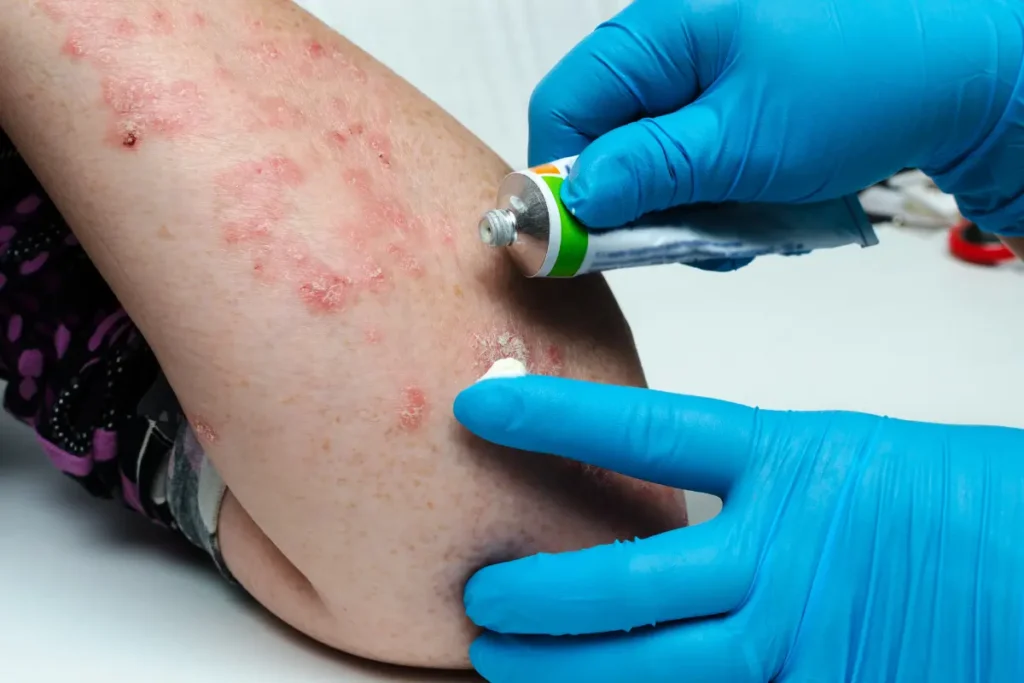
The guideline contains recommendations for treating atopic dermatitis.
Newer findings
The latest findings on the treatment of atopic dermatitis include:
- Biologics: New medicines such as dupilumab have proven effective and are now an established part of treatment.
- Microbiome: First studies show that interventions in the microbiome have an effect on eczema. However, there are no concrete recommendations yet, and further studies are needed.
- JAK inhibitors: These new medicines block specific enzymes and show promising results in reducing inflammation.
The new recommendations on local therapies, meaning treatment applied to the skin, focus on the use of moisturising creams and ointments, as well as anti-inflammatory therapy with cortisone and the cortisone alternatives, the calcineurin inhibitors.
Both classes of active substances can also be used in the flare-free interval to prevent a new flare-up. This is called proactive therapy.
The new guideline includes the option of interval therapy with JAK inhibitors, meaning a treatment with planned breaks. Some patients do not have eczema symptoms all year round. Many patients, for example, have fewer symptoms in summer. So a systemic therapy could be paused during the flare-free interval.
The newly approved antibody tralokinumab is also included in the new guideline. The antibody targets the inflammatory messenger interleukin 13.
This guideline also considers alternative healing methods
Acupuncture, phytotherapy, therapy with autologous serum and Chinese herbal medicine are not recommended for the treatment of eczema.
Process and frequency
The guidelines are revised regularly by expert groups, usually every 3-5 years. The revision process includes:
- Literature review: Analysis of the latest studies and research results.
- Expert discussions: Meetings of dermatologists and other specialists.
- Public consultation: Feedback from patient organisations and professional societies.
- Publication: Publication of the updated guideline in scientific journals and online portals.
What do I need to keep in mind about the guideline?
First and foremost, the guideline should be used as guidance for doctors when diagnosing and treating atopic dermatitis. It gives an overview of proven treatment strategies and helps people make informed decisions. However, patients can also use the guideline to find out about treatment options. If questions come up because of the medical terminology used in the guideline, your dermatologist can help. Medically validated articles in patient-friendly language, like those at Nia, can also help explain the guideline's content more simply.
Overview of current atopic dermatitis guidelines
There are several national and international guidelines for treating atopic dermatitis. The current guidelines for treating atopic dermatitis are important resources for medical professionals and patients alike. They provide comprehensive information on diagnostic criteria, treatment methods and preventive measures, based on the latest scientific findings. Here are the most important sources for the current guidelines:
- Arbeitsgemeinschaft der Wissenschaftlichen Medizinischen Fachgesellschaften (AWMF, Association of the Scientific Medical Societies in Germany): The AWMF is a central point of contact for medical guidelines in Germany. On its website, you can view and download the latest guidelines on atopic dermatitis. These guidelines are updated regularly to make sure they reflect the latest research results and best practices. Access is public and free of charge, so both doctors and patients can use the information.
- Deutsche Dermatologische Gesellschaft (DDG, German Dermatological Society): The DDG also offers guidelines on treating atopic dermatitis that are specifically tailored to the needs of doctors and patients in Germany. These guidelines are developed together with the AWMF and updated regularly. They contain practical recommendations for the diagnosis and treatment of atopic dermatitis and are available online.
- National Institute for Health and Care Excellence (NICE): NICE provides evidence-based guidelines for a wide range of medical conditions, including atopic dermatitis. These guidelines are detailed and include recommendations for diagnosis, treatment and long-term management strategies. NICE guidelines are reviewed and updated regularly to include the latest scientific findings. Current NICE guidelines are available on its website.
- American Academy of Dermatology (AAD): The AAD offers comprehensive guidelines for treating atopic dermatitis, based on the latest research results. These guidelines are designed specifically for dermatologists and other healthcare providers, but also offer valuable information for patients. The AAD updates its guidelines regularly to make sure they reflect the current state of science and clinical practice.
- European Academy of Dermatology and Venereology (EADV): The EADV provides European guidelines for treating atopic dermatitis. These guidelines give detailed recommendations for clinical practice and are the result of collaboration between experts from all over Europe. The EADV guidelines are updated regularly to take the latest research into account.
- World Health Organization (WHO): The WHO provides global guidelines for treating skin conditions, including atopic dermatitis. These guidelines are particularly useful for countries with limited resources and offer evidence-based recommendations that can be applied in different healthcare settings. The WHO updates its guidelines regularly to make sure they match the latest scientific findings.
- Other specialist journals and medical databases: Current research results and expert recommendations are often published in renowned journals such as the Journal of the American Academy of Dermatology, The British Journal of Dermatology and The Lancet. These articles often give detailed insights into new studies and clinical developments that could feed into future guidelines. These journals are usually accessed through medical libraries or online databases such as PubMed.
By using these sources, you can make sure you are always informed about the current guidelines and recommendations for treating atopic dermatitis. This is particularly important to ensure the best possible care and to put the latest scientific findings into practice.
How does the guideline help me in everyday life?
The atopic dermatitis guideline helps you understand the condition better and cope with it. Thanks to the standardised recommendations, you can:
- Use effective therapies: Find out which treatments work best.
- Take proactive measures: Learn how you can prevent flare-ups.
- Make informed decisions: Understand the scientific basis of your treatment and make a treatment decision together with your doctor, based on scientific and evidence-based findings.
More information and conclusion
To learn more about current treatment approaches, interpret symptoms correctly and regularly get important tips from experts, we recommend our Nia app. With it, you can keep a personal eczema diary, get recommendations and find articles and videos based on the AGNES eczema training. Download the app now from the App Store or Google Play and start your journey to better control of your eczema.
If you are a medical professional interested in the benefits of the Nia app and would like to use it alongside treatment, you can find more information here.
Sources:
AWMF (Arbeitsgemeinschaft der Wissenschaftlichen Medizinischen Fachgesellschaften e.V.). (2019). S2k-Leitlinie Neurodermitis (atopisches Ekzem) 013-027. https://register.awmf.org/de/leitlinien/detail/013-027
Wollenberg, A., Barbarot, S., Bieber, T., Christen-Zaech, S., Deleuran, M., Fink-Wagner, A., … & Weidinger, S. (2016). Consensus-based European guidelines for treatment of atopic eczema (atopic dermatitis) in adults and children: part I. Journal of the European Academy of Dermatology and Venereology, 30(6), 1043-1060. https://onlinelibrary.wiley.com/doi/abs/10.1111/jdv.13601
013-027l_S3_Atopische-Dermatitis-AD-Neurodermitis-atopisches-Ekzem_2023-09.pdf (awmf.org), accessed on 15.12.23