
When do I need the COVID-19 booster vaccination if I have eczema?

The current coronavirus wave is in full swing and, despite vaccinations, the number of infections keeps rising. In addition, for more and more people the primary immunisation was a while ago. They need a booster vaccination to renew their protection against the virus. Many people with eczema also got their first or second COVID-19 vaccination early on, and it is time for the booster.
Why is a third COVID-19 vaccination necessary?
The protection from the primary immunisation against COVID-19 wears off after a while, especially in older people or people with a weakened immune system. That is why the booster vaccination is particularly important for people at high risk of a severe course of COVID-19 infection. After full vaccination, they may not have sufficient protection, or their protection may wear off quickly.
Primary immunisation and booster vaccination
Building up effective vaccine protection often requires several doses. All of these doses against a pathogen together are called the primary immunisation. A booster vaccination serves to “remind” the immune system of the pathogen after some time and to maintain the protective effect of the vaccination.
The recommendation of the Standing Committee on Vaccination (STIKO) is that everyone aged 18 and over whose full vaccination was at least three months ago should receive a booster vaccination with one of the mRNA vaccines. People who received their first two vaccinations with one of the so-called vector vaccines can now also get a single booster vaccination with one of the mRNA vaccines. For children and adolescents aged 12 to 17, the recommendation is that they should receive a booster vaccination with the mRNA vaccine approved for this age group within a window of three to six months after completing the primary immunisation.
How mRNA vaccines work
mRNA vaccines belong to the new generation of gene-based vaccines. In the case of the COVID-19 vaccination, these vaccines contain the genetic blueprint for a specific component of the virus, the so-called spike protein. The spike protein sits on the surface of the coronavirus and is recognised by the human immune system as a foreign antigen. After vaccination with the mRNA vaccine, the cells use the blueprint to recreate the spike protein and release it into their surroundings. When it then meets immune cells, a specific immune response is triggered and antibodies are formed. If the vaccinated person later comes into contact with the COVID-19 virus, the antigen is recognised again and the immune system can fight it in a targeted way.
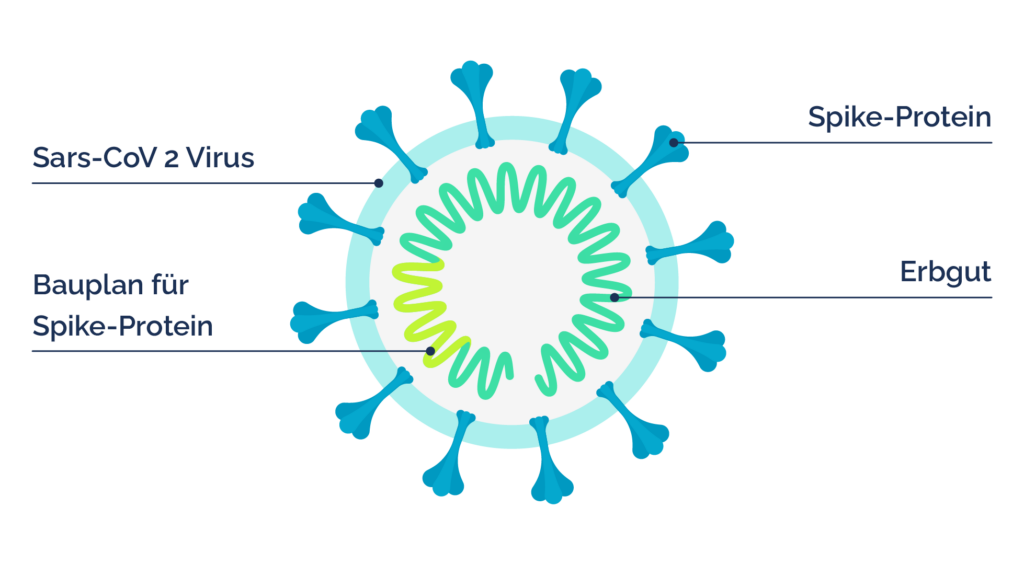
All vaccines against COVID-19 currently approved in Europe are very effective and can prevent infection with the virus in the great majority of cases. In isolated cases there are so-called “breakthrough infections”. This means that a fully vaccinated person still becomes infected with the virus and develops symptoms. As a rule, however, these symptoms are only mild, and cases requiring hospital treatment are very rare. According to STIKO, the likelihood of breakthrough infections increases as vaccine protection wears off. A booster vaccination can lower this risk and prolong the immune response.
Atopic dermatitis is not a contraindication to COVID-19 vaccination
Contraindication means that a measure such as a treatment or examination must not be carried out. Reasons for a contraindication can be certain illnesses or conditions such as pregnancy.
Atopic dermatitis is not a contraindication to COVID-19 vaccination. As with the first vaccination, the same applies to the booster: people with atopic conditions such as atopic dermatitis do not have a higher risk than the general population. Prof. Dr. Margitta Worm, head of the Department of Allergology and Immunology at Charité Berlin, also confirmed in December 2021:
“The recommendation still applies that people with atopic dermatitis, both with and without immunosuppressive treatment, should also have adequate vaccine protection against SARS-CoV-2. Having atopic dermatitis is not a contraindication.”

Prof. Dr. Margitta Worm, Charité Berlin
The Robert Koch Institute (RKI) recommends that people who had an allergic reaction after their first COVID-19 vaccination with an mRNA vaccine should not receive any further vaccination with an mRNA vaccine. Patients who have had severe allergic or anaphylactic reactions in the past should also be seen at an allergy centre before vaccination. However, for allergies that are not related to vaccine ingredients or medicines, there is nothing standing in the way of vaccination.
Can my eczema treatment affect the immune response to the COVID-19 vaccination?
Some of the medicines used to treat atopic dermatitis (e.g. corticosteroids or other immunosuppressants) suppress the immune system and can increase susceptibility to infection. The protective effect of the COVID-19 vaccination is also based on a response of the immune system. mRNA vaccines make use of the body’s immune system by triggering an immune response similar to the one against a natural virus infection. Below are some treatments that may be prescribed for atopic dermatitis:
- topical treatment
- corticosteroids and immunosuppressants
- dupilumab
- Janus kinase inhibitors
- With topical (i.e. applied externally to the skin) treatment of atopic dermatitis with corticosteroid creams or ointments, it is not expected that the immune system will be affected.
- If corticosteroids or other medicines that suppress the immune system are taken as tablets, there is a risk, depending on the medicine and the dose, that the immune system will not respond sufficiently to the vaccination. People who take medicines that act internally should talk to their doctor about possible effects on vaccination.
- Dupilumab, which is used for moderate to severe atopic dermatitis, on the other hand, is not considered immunosuppressive according to current knowledge. Even so, where possible, the vaccination can be timed so that there are about 7–10 days until the next dupilumab treatment.
- People who receive a Janus kinase inhibitor may be considered immunosuppressed, depending on the dose or form of administration. They should also talk to their doctor before vaccination. It may make sense, in consultation with the doctor, to pause treatment after the vaccination until sufficient vaccine protection has built up.
The risk-benefit balance of vaccination is positive
Just as with the first or second dose of the COVID-19 vaccination, some patients prefer to have the vaccination during a flare-free interval because of possible side effects such as fever, headache or joint pain. In some people, the vaccination itself can also lead to a slight worsening of symptoms, but this is temporary.
Even though the vaccines are highly effective, there is still a small chance of catching the coronavirus despite vaccination. However, vaccination significantly lowers the risk of severe illness and hospital stays even in case of infection, and the booster reduces it further. Experience so far with the vaccines currently approved in the EU shows that the benefit of vaccination against COVID-19 far outweighs the risks, for people with atopic dermatitis too.
Sources:
Thyssen JP et al. European Task Force on Atopic Dermatitis: position on vaccination of adult patients with atopic dermatitis against COVID-19 (SARS-CoV-2) being treated with systemic medication and biologics. J Eur Acad Dermatol Venereol. 2021 May;35(5):e308-e311. doi: 10.1111/jdv.17167. Epub 2021 Mar 7. PMID: 33587756; PMCID: PMC8014632.
Diotallevi F et al. Vaccines for COVID-19 in patients with atopic dermatitis: three things every dermatologist should know. Acta Dermatovenerol Alp Pannonica Adriat. 2021 Jun;30(2):67-69. PMID: 34169702.
Wack S, Patton T, Ferris LK. COVID-19 vaccine safety and efficacy in patients with immune-mediated inflammatory disease: Review of available evidence. J Am Acad Dermatol. 2021 Nov;85(5):1274-1284. doi: 10.1016/j.jaad.2021.07.054. Epub 2021 Aug 4. PMID: 34363909; PMCID: PMC8336973.
https://www.rki.de/SharedDocs/FAQ/COVID-Impfen/gesamt.html, accessed on 7.12.2021
https://www.rki.de/SharedDocs/FAQ/COVID-Impfen/Flowchart_Allergieanamnese.pdf?__blob=publicationFile, accessed on 7.12.2021
https://www.pei.de/DE/newsroom/positionen/covid-19-impfstoffe/stellungnahme-allergiker.html;jsessionid=9868B0A95BE874D8593B89DE2CA7464A.intranet231?nn=169730, accessed on 7.12.2021