
Atopic keratoconjunctivitis
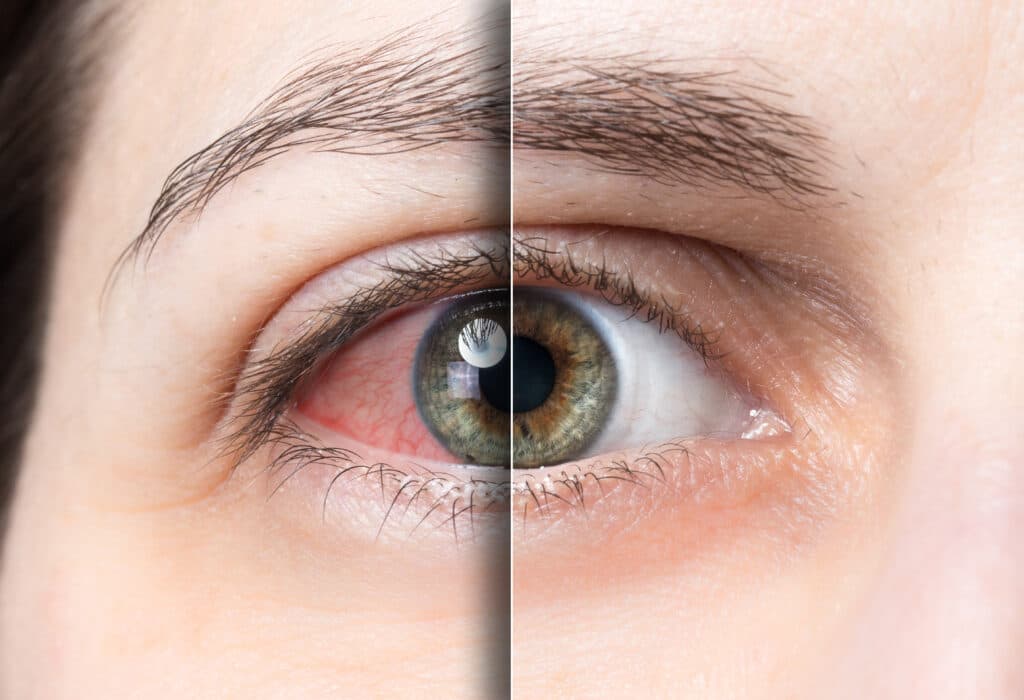
When eczema appears on visible areas of skin, those affected often suffer a great deal. It is particularly nasty when eczema shows up in the eyes. This is usually atopic conjunctivitis: an eye disease that is very dangerous and can even reduce your eyesight.
Eczema and atopic keratoconjunctivitis
In addition to the typical skin symptoms, eczema also shows up in the eyes in 20 to 43% of those affected. This can be atopic conjunctivitis (allergic inflammation of the conjunctiva) or keratitis (inflammation of the cornea). In many cases, there is even a combination of inflamed conjunctiva and cornea, known as atopic keratoconjunctivitis.
Filaggrin: an important protein for skin and eyes
Filaggrin is a protein that is important for the skin's barrier function. In people with eczema, the filaggrin gene is often mutated. Because of the mutation, a filaggrin protein is produced that cannot perform its function properly. The result is a reduced skin barrier function, which brings with it the typical eczema symptoms.
The filaggrin protein also plays a role in the eye. That is why research is discussing whether the faulty filaggrin protein could also be responsible for the eczema symptoms in the eyes.
In addition, a high number of mast cells in the conjunctiva and eyelid favours an allergic reaction in the eye. Mast cells are cells of the immune system. In an allergic reaction, the immune system is activated excessively after contact with allergens. As a result, pollen or house dust mites can cause atopic keratoconjunctivitis in the eye.
Symptoms of atopic keratoconjunctivitis
The eye can be affected by atopic as well as by infectious conjunctivitis. Infectious conjunctivitis is caused by viruses or bacteria. Atopic keratoconjunctivitis, on the other hand, is caused by allergens such as pollen, house dust mites or animal hair.
The symptoms of both forms of conjunctivitis are similar:
- red eyes
- itchy eyes
- a feeling of a foreign body in the eye
- swollen eyelids
However, there are also differences. In atopic keratoconjunctivitis
- the symptoms are often more severe.
- unlike infectious conjunctivitis, both eyes are usually affected.
- the lower eyelid can become cracked.
- some people affected are sensitive to light
- it takes longer during treatment for the symptoms to improve.
Caution: Please don't rub your eyes! Severe atopic conjunctivitis can lead to long-term damage and impaired vision. Rubbing your eyes increases the risk of these complications
Atopic keratoconjunctivitis needs a different treatment from infectious conjunctivitis. That is why it is very important to get a reliable diagnosis from a doctor, who will draw up a specific treatment plan.
Treatment of atopic keratoconjunctivitis
The symptoms of atopic keratoconjunctivitis can be similar to those of infectious conjunctivitis. The treatment, however, is different. For example, conjunctivitis caused by bacteria is often treated with antibiotic eye drops. Antibiotic eye drops, however, do not help with atopic keratoconjunctivitis.
For atopic conjunctivitis, a local therapy made up of the following possible components is used:
- careful cleaning of the edge of the eyelid
- eye drops without active ingredients and without preservatives
- anti-inflammatory and anti-allergic eye drops (active substances: antihistamines, mast cell stabilisers, cyclosporin A, calcineurin inhibitors, corticosteroids)
If the local therapy does not work as expected, atopic conjunctivitis is treated systemically. This means that those affected take tablets with active substances (e.g. corticosteroids or immunosuppressants), which then act throughout the whole body.
Prevention
Have you been diagnosed with eczema and do you know that you are allergic to pollen, animal hair or house dust mites? Then you can do the following to reduce the likelihood of developing atopic conjunctivitis.
Conclusion Atopic keratoconjunctivitis is a severe inflammation of the eyes that can occur alongside eczema. If you notice symptoms of atopic keratoconjunctivitis, you should see an eye doctor straight away.
Sources:
Augenbeteiligung bei atopischer Dermatitis | SpringerLink; accessed: 21.10.2022
Atopic keratoconjunctivitis: A review – PubMed (nih.gov); accessed: 21.10.2022
Pathogenesis and complications of chronic eye rubbing in ocu… : Current Opinion in Allergy and Clinical Immunology (lww.com); accessed: 26.10.2022
Allergie_des_Auges.pdf (charite.de); accessed: 27.10.2022
kl1267 512..517 (thieme-connect.com); accessed: 27.10.2022