
Eczema in Black people: diagnosis and treatment

Chronic skin conditions can affect people of every background and ethnicity, so eczema can also occur in Black people. More than one million people of African descent live in Germany. Eczema on dark skin can come with some challenges, because unfortunately racism does not stop at the German healthcare system either. Here you can find out how to recognise eczema in Black people.
Eczema is more common in Black people
People of African or Indian descent often have darker skin tones than most people of European ethnicity. Darker skin tones differ from lighter ones not only in their pigmentation. From the classification of the six skin types, for example, we know that skin type VI is less prone to sunburn and skin cancer than light skin types.
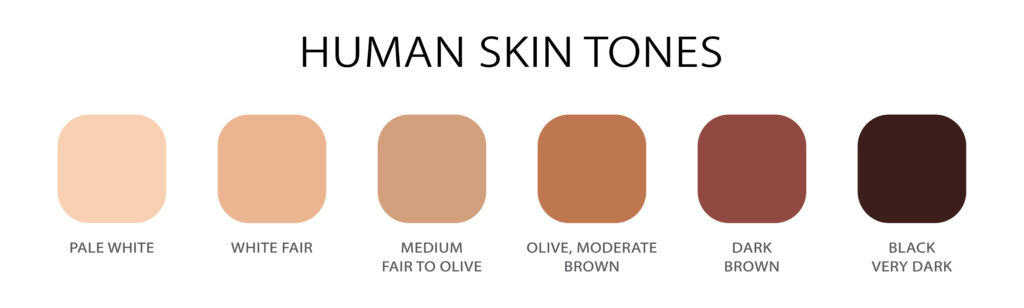
Sketch of the six skin types, with “pale white” showing skin type I and “black, very dark” showing skin type VI.
Eczema is more common in Black people than in White people. Darker skin types also tend to become dry more quickly. For example, a study in the USA found that over 19% of African Americans have atopic dermatitis. By comparison, only about 16% of White people and 7.8% of people of Asian ethnicity had atopic dermatitis. The reasons for this still need further research.
Same skin condition, different mechanisms
Atopic dermatitis is a multifactorial disease, and genetics plays a decisive role in how it develops. However, certain triggering factors for atopic dermatitis vary with ethnicity. Patients of European descent mainly have a defect in the so-called filaggrin protein. People with dark skin types, on the other hand, usually do not have this mutation. Instead, their total immunoglobulin E (total IgE) seems to be particularly raised.
How eczema shows up in Black people
For doctors, diagnosing eczema in Black people can be challenging, because many picture eczema as a red, itchy rash (erythema). In people of African ethnicity, however, erythema may be less common and look different. It often looks purple or burgundy. That is why, when diagnosing eczema in Black people, particular attention should also be paid to the following symptoms:
Swelling
Dryness, scaling
Folds of skin below the lower eyelid (Dennie-Morgan fold)
More creases on the palms of the hands (palmar hyperlinearity)
Itching and weeping skin
The itch in particular can be more intense. Severe courses also seem to be more common than in White patients. Yet the clinical scoring systems used as standard underestimated the severity of eczema in people of colour.
Because of structural racism in healthcare, the quality and availability of medical care for people of colour can be limited.

Eczema in Black people also shows up with the typical itch
Structural racism in healthcare
Structural racism means that certain structures and processes in society create disadvantages for people of colour. This can even happen unconsciously. For example, most medical textbooks only show White people. As a result, medical staff are often not trained for skin of colour at all. On top of this, Black people are often assumed to have a language barrier when they see a doctor, even when there isn't one. There are similar misconceptions about pain tolerance, which is often overestimated in non-White people.
Eczema research, too, often includes only White people in its studies. This means there is a lack of meaningful evidence on targeted, individual treatment options for people of colour. However, the standard treatments seem to be effective in ethnicities other than White as well (Croce et al., 2021):
- Topical corticosteroids (cortisone): Similar effect in all skin types. However, high-strength preparations can cause hypopigmentation (lightening of the skin colour) in dark skin.
- Topical calcineurin inhibitors: Similar effect in all skin types.
- Phototherapy (light therapy): Phototherapy in the 340 to 400 nm range (UVA1) is effective in all skin types. Irradiation with the short-wave part of UV light (UVB) requires higher doses in darker skin types. With dark skin types, treatment should not last too long, to avoid side effects.
- Biologics: Similar effect in all skin types, but people with skin of colour are underrepresented overall (little data).
Eczema treatment is roughly the same for all ethnicities.
Disadvantages for people of colour from deep-rooted racism
But researchers in the USA are also observing other factors that have a negative effect on eczema. Racism can also affect social status (income, educational opportunities) or environmental factors. For example, Black people are more often exposed to air pollutants because they are more often disadvantaged when it comes to housing. Both environmental factors and social status can contribute to the development of eczema in Black people.
Unfortunately, racism does not stop at eczema either. A lot still needs to happen in politics and healthcare. We hope this article draws a little more attention to this important topic. Because Nia wants to support you in managing your eczema, whatever your skin colour or ethnicity.
Sources:
- Narla, S., Heath, C. R., Alexis, A., & Silverberg, J. I. (2022). Racial disparities in dermatology. Archives of dermatological research, 1–9. Advance online publication. https://doi.org/10.1007/s00403-022-02507-z
- Martinez, A., de la Rosa, R., Mujahid, M., & Thakur, N. (2021). Structural racism and its pathways to asthma and atopic dermatitis. The Journal of allergy and clinical immunology, 148(5), 1112–1120. https://doi.org/10.1016/j.jaci.2021.09.020
- Brunner, P. M., & Guttman-Yassky, E. (2019). Racial differences in atopic dermatitis. Annals of allergy, asthma & immunology : official publication of the American College of Allergy, Asthma, & Immunology, 122(5), 449–455. https://doi.org/10.1016/j.anai.2018.11.015
- Sachdeva, M., & Joseph, M. (2022). Dermatology: how to manage atopic dermatitis in patients with skin of colour. Drugs in context, 11, 2021-12-1. https://doi.org/10.7573/dic.2021-12-1
- Croce, E. A., Levy, M. L., Adamson, A. S., & Matsui, E. C. (2021). Reframing racial and ethnic disparities in atopic dermatitis in Black and Latinx populations. The Journal of allergy and clinical immunology, 148(5), 1104–1111. https://doi.org/10.1016/j.jaci.2021.09.015
- https://nationaleczema.org/blog/eczema-in-skin-of-color/, accessed on 03.06.2023
- https://www.ndr.de/ratgeber/gesundheit/Diskriminierung-von-People-of-Colour-in-der-Medizin,diskriminierung158.html, accessed on 06.04.2023