
Functions and roles of the skin

The skin doesn’t just protect us from harmful environmental influences — it is also the largest organ in our body and plays an important role in sensory perception. Through the skin, we perceive touch and temperature stimuli. The skin is also involved in regulating our body temperature, and it’s through our skin that we sweat or get goosebumps in the cold.
The skin is in constant exchange with the outside world. It can absorb substances and store water, fats, or salts, whilst also releasing substances and excreting metabolic products.
Key functions of the skin
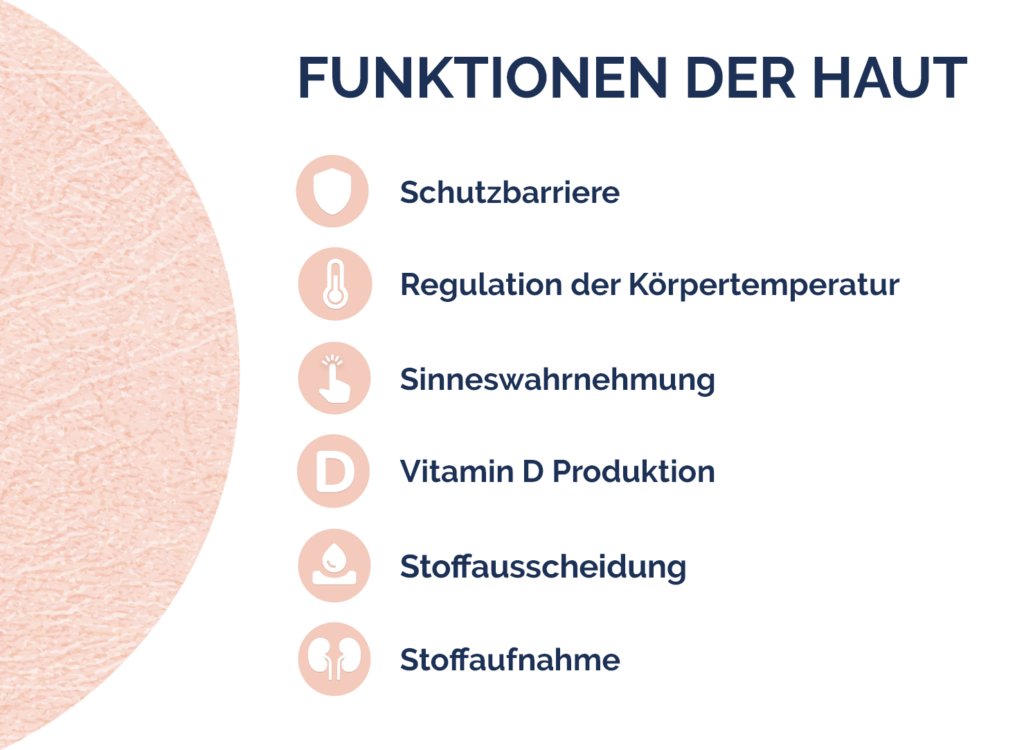
1. Protective barrier
The skin is our outer covering and forms a protective barrier between our body and the environment. The stratum corneum of the skin has what is known as a natural acid mantle, with a pH value (a measure of acidity) of around 5.5. It protects the body from external stimuli, and an intact acid mantle is important for preventing pathogens from penetrating the skin.
To reduce damage caused by UV radiation, there are specialised pigment cells in the outermost layer of the skin. Another function of the skin is protection against water loss. This is aided by the skin’s unique composition, which includes substances that help to reduce moisture loss.
2. Temperature regulation
The skin plays a role in regulating body temperature. It can release heat, for example through evaporation during sweating. The subcutaneous fatty tissue provides protection against the cold by acting as a heat store. Reduced blood flow to the skin in cold conditions also helps to minimise heat loss.
3. Exchange of substances
Absorption: The skin can absorb water, fats, and other substances from the outside. This applies, for example, to medications applied to the skin. The active ingredients in ointments and creams are absorbed through the skin.
Excretion: The skin is also an excretory organ. By releasing water and salts (e.g. through evaporation during sweating), the skin helps to regulate the body’s mineral balance.
4. Vitamin D production
Vitamin D is essential for our health, as it plays an important role in calcium metabolism and bone health. Only a small amount of vitamin D is obtained through food; the majority is produced in the skin with the help of sunlight. When UV radiation hits the skin, the production of the vitamin is stimulated through a series of intermediate steps.
Important: Too much sun can cause skin damage and even skin cancer. Time spent in the sun should therefore be limited and guided by your skin’s natural protection time. Find out more about sun protection for atopic dermatitis here.
5. Sensory perception
We perceive a wide range of stimuli through our skin. For this purpose, the skin contains various sensors that detect pressure, temperature, and pain stimuli and pass them on to the nerves. In some areas, such as the fingers or face, there are particularly high concentrations of sensory receptors, allowing us to perceive even the finest stimuli. The detected stimuli are converted into electrical impulses and transmitted along nerve fibres to the brain.
The connection between skin and the mind
The condition of our skin can also have a significant impact on our wellbeing. The skin is often described as a mirror of our inner state and frequently reveals our emotions. A wide range of feelings manifest in the skin. For example, we blush with embarrassment, fear gives us goosebumps, or makes us break out in a sweat.
There are numerous connections between the skin and the mind, and research has increasingly focused in recent years on the role that psychological factors play in skin health.
Sources:
- https://journals.lww.com/jdnaonline/fulltext, accessed 13.03.2022
- https://viamedici.thieme.de/lernmodul/histologie/haut, accessed 14.03.2022
- Yousef, H., Alhajj, M., & Sharma, S. (2021). Anatomy, Skin (Integument), Epidermis. In StatPearls. StatPearls Publishing.
- Fore J. (2006). A review of skin and the effects of aging on skin structure and function. Ostomy/wound management, 52(9), 24–37.