
The skin's barrier function

What you will have learned after this article
Most people know that "heredity" plays a role in eczema. Beyond that, this article aims to give a deeper understanding of this topic. Too often, parents of affected children still suspect external factors alone as the cause of eczema. This training unit aims to deepen knowledge relevant to the disease. A better understanding, including of the clinical relevance of the genetic predisposition (= reduced barrier function) in eczema, is meant to strengthen parents' motivation to carry out the corresponding treatment measures consistently. Explaining the barrier function disorder is therefore one of the key contents of the training.
The skin's barrier function
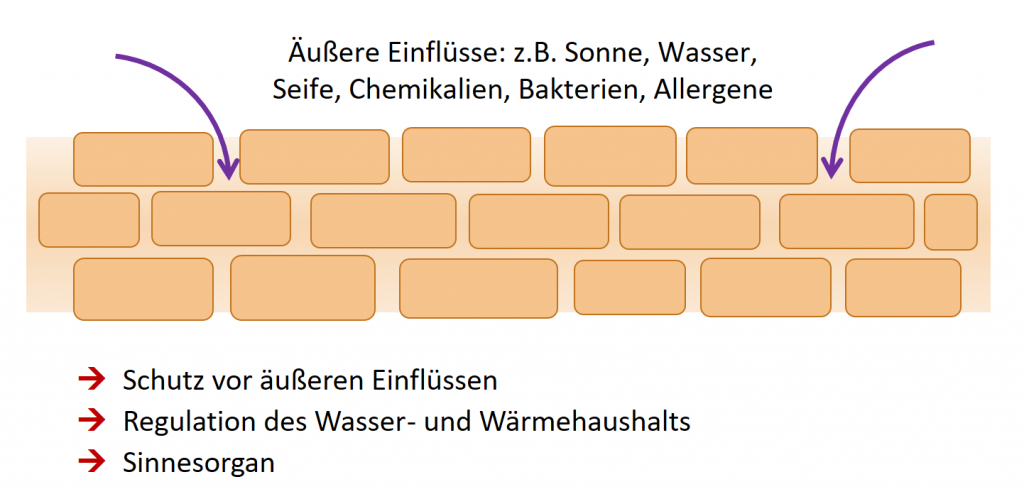
Handout from AGNES "Neurodermitsschulung – Eltern", learning objective 2.3
Functions of the skin
- Physical protection
- Chemical protection
- Temperature regulation
- Storage and excretory organ
- Sensory organ
- Communication
The skin has a protective and barrier function. Various (protein-rich) skin cells and certain skin fats (lipids), especially in the upper (horny) layers of the skin, make sure the skin holds together firmly, forming a barrier. As a result, bacteria or allergens cannot get through the skin so easily. Conversely, water, for example, cannot escape from the upper layers of the skin and evaporate so easily.
Disturbance of the skin's barrier function
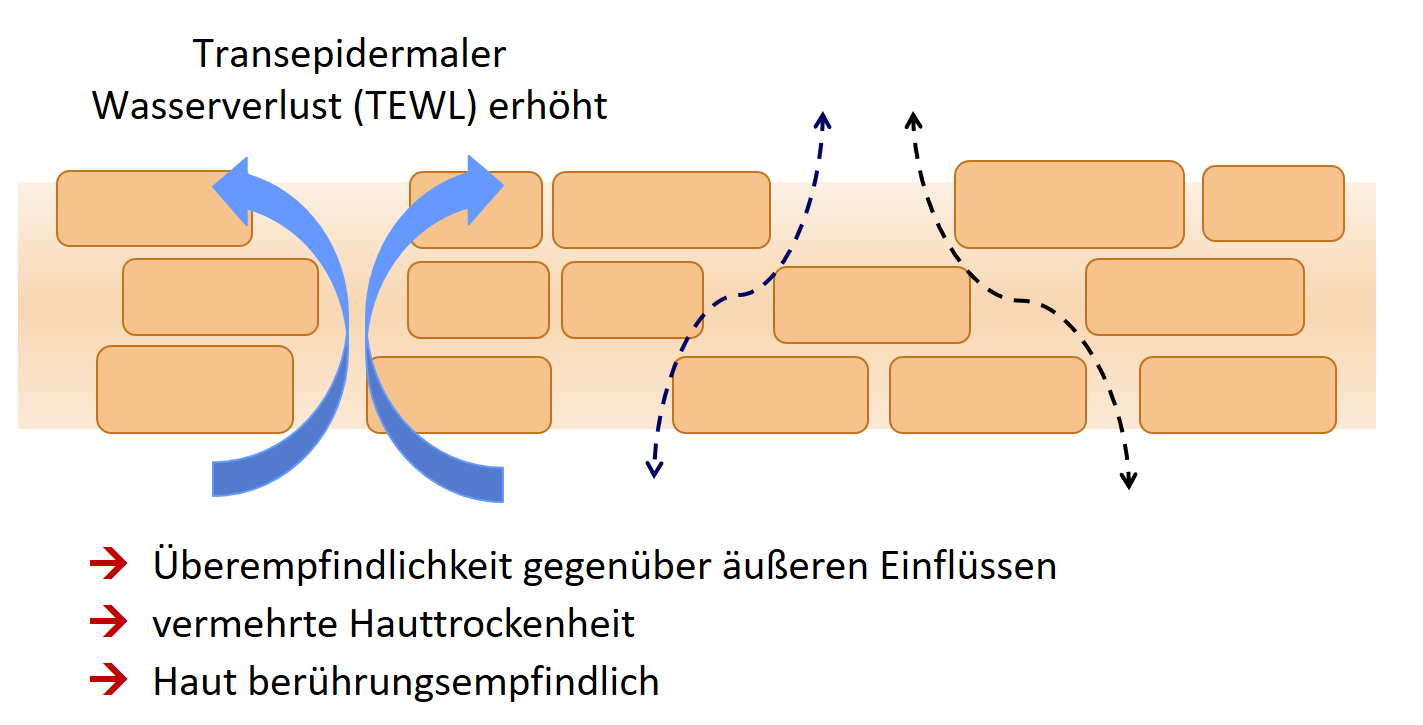
Handout from AGNES "Neurodermitsschulung – Eltern", learning objective 2.3
Changes in the skin with eczema
- Disturbance of the skin barrier function (dry skin)
- Inflammatory cells migrating into the skin
- Presence of pro-inflammatory messenger substances and antibodies ("IgE") in the inflamed skin –> thickening of the skin, formation of small blisters, weeping, itching
- Colonisation of the skin by certain germs (often staphylococci)
In eczema, the skin barrier is disturbed: harmful or pro-inflammatory substances from outside can get in more easily (including bacteria or allergens), and water can escape more easily. The skin is dry and becomes inflamed more easily, and allergic sensitisation appears to happen more easily.
Causes of the missing firm cohesion, especially of the upper (horny) layers of the skin, can
- lie in a reduced composition of the skin fats or of the connections between the individual (horny) skin cells. For example, patients with changes in the structural protein "filaggrin", which is particularly important for the cornification of skin cells, have dry skin and an impaired skin barrier function.
- be inflammatory messenger substances (e.g. after contact with an allergen), which lead to a disturbance of the skin barrier with inflamed skin and damage the firm cohesion of the cells.
This makes it all the more important to strengthen the barrier with consistent basic therapy.
The text comes from module 2.3 of the 2nd edition of the parents' eczema training manual (Eltern Neurodermitisschulung Manual) of the Arbeitsgemeinschaft Neurodermitisschulung e.V. (AGNES) | Copyright 2017 AGNES