
Basic skin care: eczema in adults
Basic skin care is essential for the skin of people with eczema. Even when you have no symptoms, it is important to care for your skin regularly with moisturising creams, ointments and oil baths. Good basic skin care can often even lengthen the symptom-free intervals.
Using creams and ointments according to your skin’s condition
http://nia-health.de/welche-neurodermitiscreme-ist-die-richtige-fuer-dich/In people with eczema, the protective barrier function of the skin is impaired. This makes the skin more permeable to foreign substances such as germs or allergy-triggering substances from the environment. It also loses more moisture and dries out more quickly. That is why many people with eczema find it helps to apply cream to their skin every day, even when no inflamed patches can be seen. Patients often tolerate products without fragrances, colourings or preservatives better.
For basic eczema skin care, the rule is “moist on moist, greasy on dry”. This means: the stronger the inflammation, the more moisture the cream can contain, and the better the condition of the skin, the greasier the cream can be. Skin care in summer often looks different from skin care in winter. Creams or lotions with a higher water content tend to be used in summer, and ointments with a higher fat content tend to be used in winter.
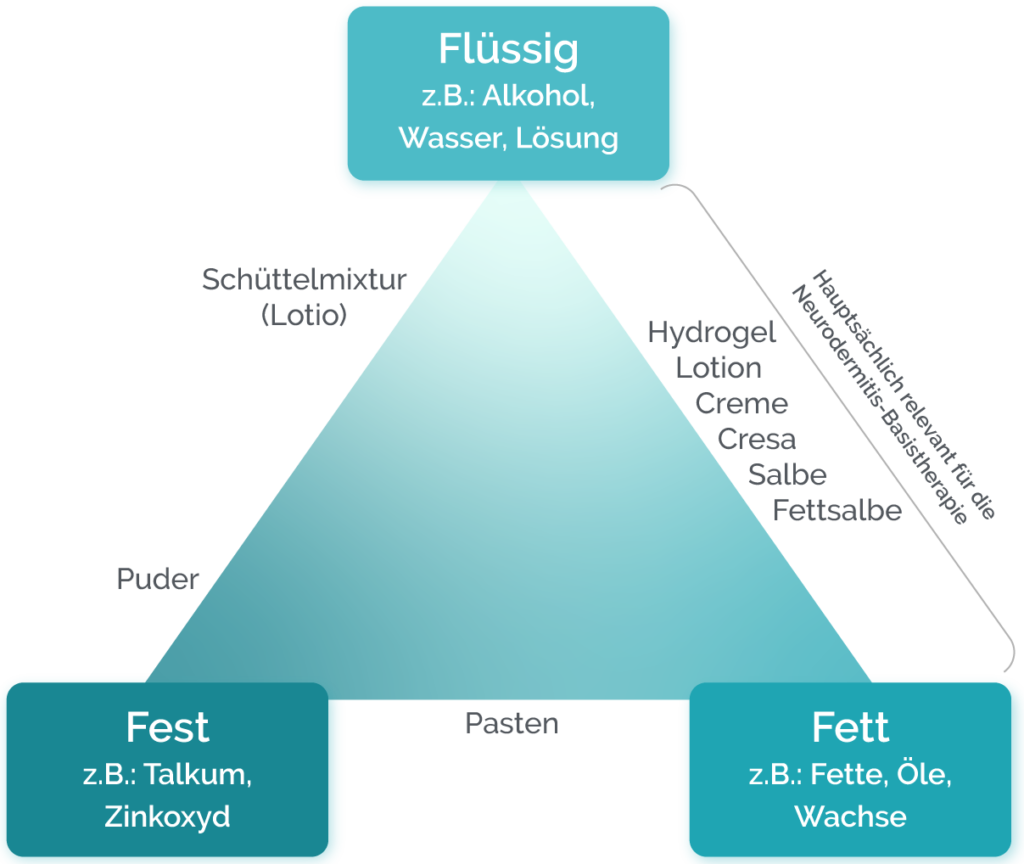
Chart of basic eczema skin care – which cream for which skin
Cleansing the skin as part of basic eczema skin care
Regular cleansing of the skin is also important in basic eczema skin care, for example with short baths that are not too hot (about 34 degrees Celsius). Soap-free, pH-neutral products are suitable for cleansing, and so-called “spreading” oil baths can be used as a bath additive; they leave a fine protective film on the skin. After cleansing, it can also help to just gently pat the skin dry and then apply cream.
Relieving itch with wet wraps and creams containing urea
Treating the itch is especially important, as patients often find it particularly tormenting. Scratching also damages the skin, the inflammation gets worse and a vicious circle can start, which you want to prevent. Wet wraps can bring relief from itching, and wraps with black tea also work well for some patients (you can read more about home remedies for eczema here).
Creams and lotions containing urea often relieve itching particularly well, but the substance can sting on the skin, especially in children. In these cases, products with glycerin can be used instead. Creams with polidocanol, a substance with a local anaesthetic effect on the itch, can also ease the symptoms.

Chart of the itch-scratch cycle – basic eczema skin care
Finding the right care product with the right-left comparison
There is a wide range of special care products tailored to the needs of the skin of people with eczema. It is best for patients to try out for themselves which products suit them best and which they tolerate well. One good way to find out is the right-left comparison. For one week, you apply cream X to your right arm and, at the same time, cream Y to your left arm. The cream that works less well is then swapped out the following week. So week by week, two creams compete against each other, and step by step you get closer to the cream that works best for your individual situation.