
The interaction between itching, scratching and inflammation of the skin
What you will have learned after this article
Even the most patient parents of affected children know that the agonising itch can have a far-reaching impact on family life. Reducing itching through therapeutic measures therefore contributes significantly to the quality of life of the child and the family. This article aims to give you a deeper understanding of the link between itching and inflammation of the skin. Hopefully, this will spark more motivation and perseverance for carrying out the therapeutic measures for eczema consistently.
The itch-scratch cycle
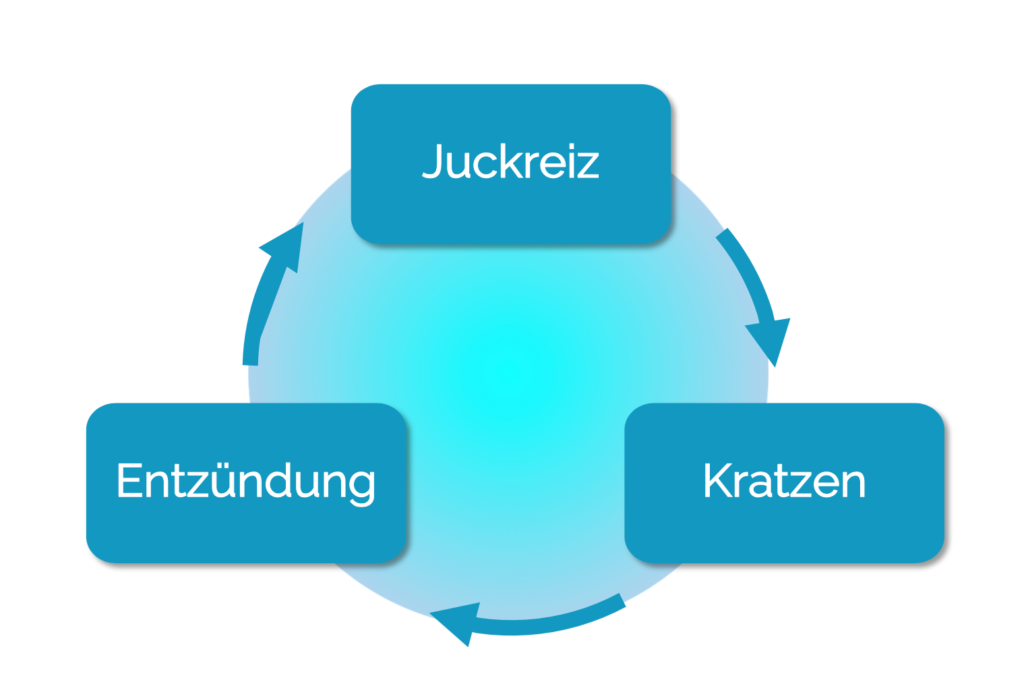
How does the itch-scratch reaction develop?
Itching is a complex, multifactorial sensory perception. Various centres in the brain are involved in the scratching reaction that follows an itch or an inflammatory pain perceived via the nerves in the skin: 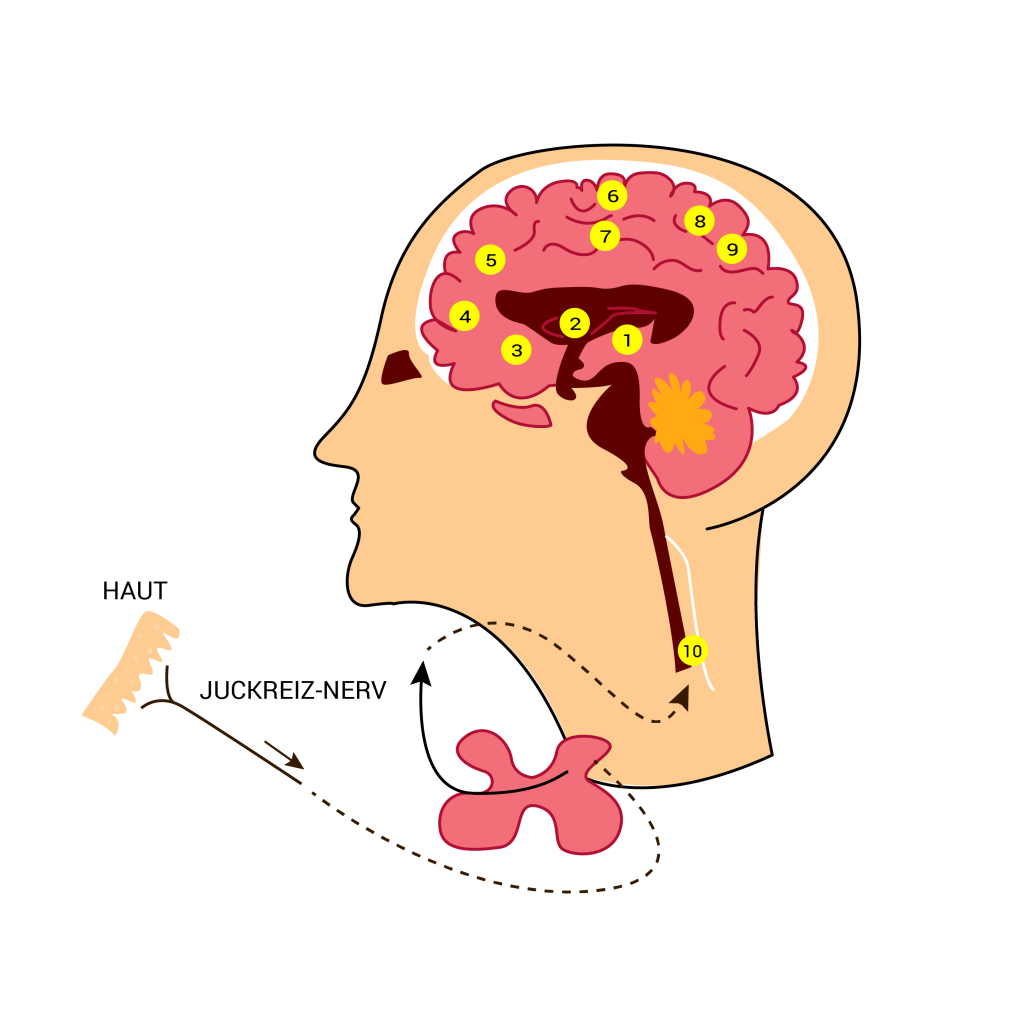
- No. 1 = thalamus: the brain's receptionist (it distributes the information to the brain centres. This itch information has arrived via nerve pathways through the spinal cord (no. 10). It is let through upwards as far as the "reception". From there, the information is passed on to the following brain centres:
- No. 2 = "insula": centre responsible for decisions/empathy/compassion, assessment of pain and itching
- No. 3 = orbitofrontal cortex: responsible for integrating perceived sensations, decision-making, reward, punishment; actions are planned and initiated (example: "do I reward myself?" by suppressing my itch by scratching, or "do I punish myself?" because I bleed afterwards)
- No. 4 = prefrontal cortex: distinguishes between conflicting thoughts, connects feelings and action, distinguishes good and evil, keeping to social rules (e.g. "should I scratch my skin until it bleeds in front of my classmates now so that the itching stops?")
- No. 5 = cingulum: responsible for connecting emotions, behaviour and thinking
- No. 6 = supplementary motor area: responsible for planning movements and organising movement sequences (e.g. rhythmic scratching)
- No. 7 = premotor cortex: responsible for starting actions and setting these actions in motion
- No. 8 = primary somatosensory cortex: responsible for localising the perceived stimulus, its duration and intensity (e.g. perceiving whether it is just a brief bout of itching or whether it lasts longer and I would need to react, e.g. with a cooling cream etc.)
- No. 9 = secondary somatosensory cortex: responsible for further processing of the "primary sensorimotor cortex"
This shows that the scratching behaviour of a person with eczema is so complex that it can take different forms depending on the situation, and that influence from outside will be more successful at some times and less at others, depending on which brain centres are activated. On the other hand, one will always try to bring about reduced scratching behaviour through suitable conditioning; for example, it is known that progressive muscle relaxation has a calming effect on no. 8 and no. 9, i.e. the decision to scratch becomes weaker through self-hypnosis. The primary sensorimotor area responds to stimuli from the skin and the muscle spindles, which are "addressed" in the sense of tensing and relaxing, e.g. in PMR or autogenic training.
What is the itch memory?
Inflammatory mediators (chemical substances from inflammatory cells in the skin in eczema) stimulate the "itch nerves" in the skin. The skin nerves then "radio" the itch to the brain, where the intense daily scratching activity develops a huge area for the motor scratching response. This in turn leads to an automatism: the fingers "automatically" curl up to scratch. In a similar way, a professional footballer has a huge brain area for his foot movements and can inexplicably curl balls round the corner into the goal (we speak of a "goal-scoring instinct"), and a violinist manages the most virtuoso finger work for a violin concerto because the brain areas for the hands and for particular gripping and bowing movements have grown larger. In the case of eczema, however, the scratching movement and the fingers bent to scratch are not to be seen as a positive achievement or talent: the scratching movement, through touching the skin itself, can stop the itching, but as a result, inflammatory messenger substances are formed and released again in the epidermis, which fuels the vicious circle of "itching – scratching – skin sensitivity/inflammation". Even a minimal stimulus (a breath of wind, a touch, "embarrassment scratching") can eventually remind the itch memory that it is time to scratch again. We rate itching, like pain, on a scale from 0 = no itching to 10 = the most intense itching imaginable. We know from pain that longer-lasting pain from a level of 3 on the scale and above creates a pain disease or a pain memory. It is exactly the same with itching. The itching now becomes a disease in its own right, which parents observe in their children and describe like this: "When my child gets undressed, they immediately start scratching, even though they were playing quite peacefully just before. They scratch and scratch and can't stop. Sometimes I feel the itch is somehow 'engraved'. And even though I can't see any eczema on the skin any more, my child scratches."
What can you do to prevent the itch memory?
The be-all and end-all is basic therapy, which makes sure that the skin gets enough water and fat and that dryness alone does not already make you scratch.
Can the itch memory be made to disappear again?
As with any habit, you can try to do this here too. The younger a child is, the better it works. This requires being willing to treat inflammation of the skin very regularly from the outside with the adapted, usually cortisone-based, therapy. While in adults antidepressants and neuroleptics often have to be used from the inside, because the anti-inflammatory therapy from the outside alone is no longer effective, a great deal can be achieved in children and adolescents with ointment therapy appropriate to the stage. The goal is a significant reduction of the inflammatory substances in the skin that constantly stimulate the itch nerves to radio the brain. Using proactive therapy helps to leave the itch memory in peace and to "train down" the "control centre" for scratching hand movements in the motor cortex (breaking the habit). Proactive therapy means that, once the skin has healed, you continue to apply an anti-inflammatory ointment (containing glucocorticosteroids or calcineurin inhibitors) to former eczema areas 1 to 2 times a week for a period set by your doctor. Measures such as cooling, distraction and alternative ways of touching the skin can also help, but are not suitable as the only measure.