
Eczema: key terms and definitions

What you will have learnt after this article
Parents are often flooded with countless pieces of information about the condition "eczema". This article explains the terms that matter for the condition. After reading it, parents will also find it easier to place eczema in the context of possible accompanying conditions and to tell it apart from other skin diseases.
What follows is a first overall picture of the condition, as a basis for building a deeper understanding.
What is eczema?
Eczema is an inflammatory, non-contagious skin disease that usually runs in flare-ups over a long period of time (i.e. it is chronic) and comes with severe itching. Other names for eczema are: "atopic dermatitis", "atopic eczema", "endogenous eczema".
Who is affected by the condition?
The condition mainly affects children: eczema is the most common chronic disease in childhood. About 60% of those affected develop it within the 1st year of life, and 70-85% develop it by the age of 5. A third of affected children still have symptoms of eczema in adulthood.
What are possible causes of eczema?
The causes of eczema are varied. On the one hand, eczema is based on a genetic predisposition (atopy). This is a complex interaction of different genes, in which gene variants and (altered) gene functions also play a role. On top of this comes a large number of possible triggers (trigger factors) for the inflammation of the skin, which matter to a different degree from child to child (e.g. irritation of the skin from certain clothing, sweating; infections; positive/negative stress; tobacco smoke; colonisation of the skin with certain bacteria/viruses; allergies).
Possible triggers (trigger factors)
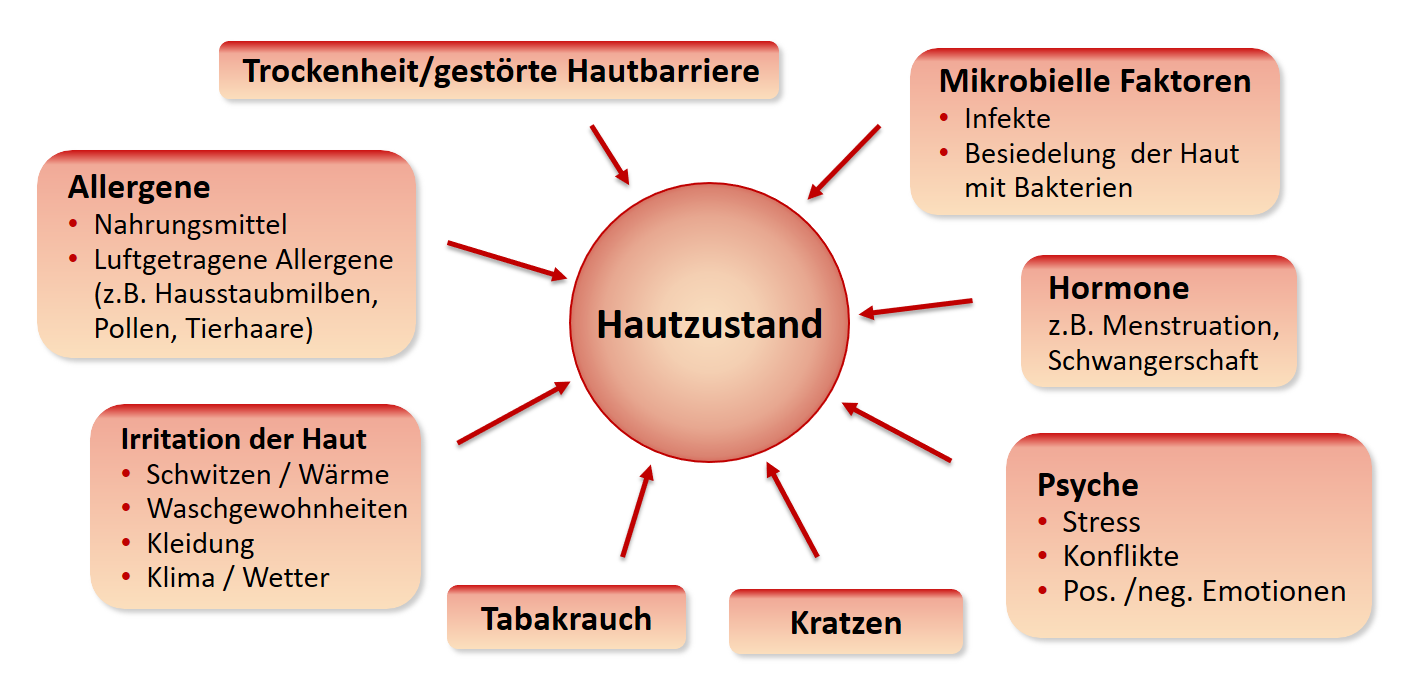
Handout from AGNES "Neurodermitsschulung – Eltern" (eczema training for parents), learning objective 2.5
The genetic predisposition and triggers that differ from person to person underlie the disturbed skin barrier function in eczema.
Barrier function of the skin
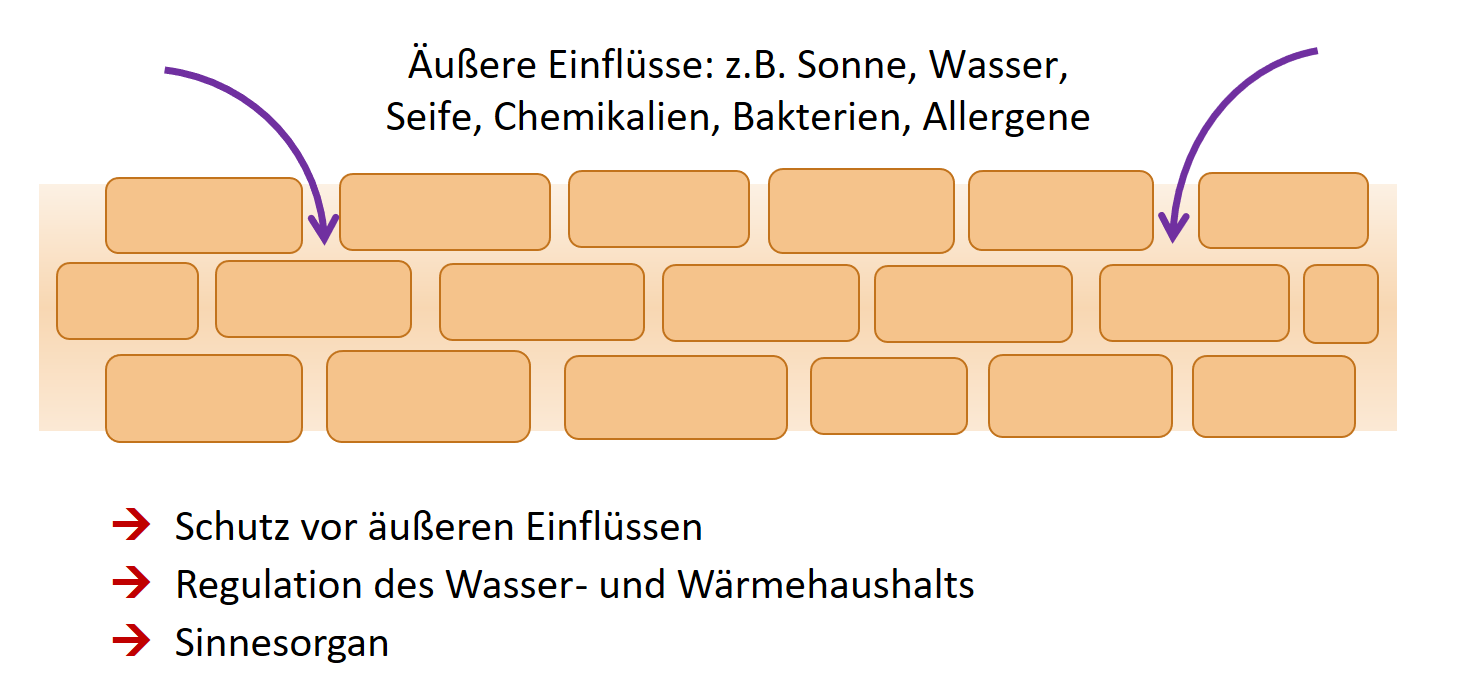
Handout from AGNES "Neurodermitsschulung – Eltern" (eczema training for parents), learning objective 2.3
The atopic predisposition cannot be influenced. What can be influenced, however, is how you deal with the triggers and the inflammation of the skin.
What is an allergy?
An allergy is a hypersensitivity reaction to harmless substances in the environment. People with atopy suffer from allergies more often. Triggers of an allergy (= allergens) can be airborne substances in the environment (e.g. house dust mites, tree or grass pollen, animal hair) or also foods. This is why the atopic diseases also include bronchial asthma, allergic rhinoconjunctivitis ("hay fever") and food allergies.
The following symptoms can occur in an immediate allergic reaction: sudden restlessness, itching, watery eyes, runny nose, swelling of the skin/ in the mouth/ airways, reddening of the skin, wheals ("hives"), shortness of breath up to respiratory arrest, nausea, vomiting, diarrhoea, circulatory weakness up to circulatory arrest. In a subgroup of children, contact with an allergen can also lead to an eczema flare-up (late allergic reaction).
What role do foods play?
Food allergies are observed more often in patients with eczema. Certain foods can therefore be a trigger (trigger factor) of eczema – but not in all children, only in a subgroup of those affected, who usually have a more severe course of eczema.
The text comes from module 2.1 of the 2nd edition of the Eltern Neurodermitisschulung Manual of the Arbeitsgemeinschaft Neurodermitisschulung e.V. (AGNES) | Copyright 2017 AGNES