
15 tips for gentle hair removal with eczema
Stretching your legs out in the summer sun: many people like to do this with smooth, hair-free skin. But hair removal can be very hard on the skin. Whether shaving, epilating, waxing, sugaring or laser, in this article you will learn which options are best suited to eczema.
Shaving causes tiny skin injuries
Shaving is a simple and quick method. It is also painless and works best after a shower, when the skin is soft and clean. For less irritation, the following tips are recommended:
Only use sharp blades
If you are allergic to nickel: check what material the blade is made of
Rinse the blade with water every few strokes
Be gentle and don't press hard
Shaving foam helps avoid small injuries
Shave in the direction of hair growth
With shaving, the result only lasts a very short time. Shaving again often puts extra strain on the skin. Shaving also causes so-called microtraumas. These are tiny injuries to the skin where bacteria can settle. That is why the skin needs some time to regenerate. Greasy creams should be avoided then, so that the bacterial colonisation of the skin does not get worse.
Sugaring as gentle hair removal
Unlike shaving, waxing and sugaring remove the hair together with the root. This means it takes longer for the hair to grow back. The result can last up to 4 weeks. How painful these hair removal methods are is different for each person. However, many people with sensitive skin prefer sugaring, because, unlike with waxing, the paste is pulled off in the direction of hair growth. Wax has to be heated for waxing to work, and there is a warning about burns if the wax is applied too hot. With sugaring there is no risk of burns, because the paste only needs to reach body temperature.
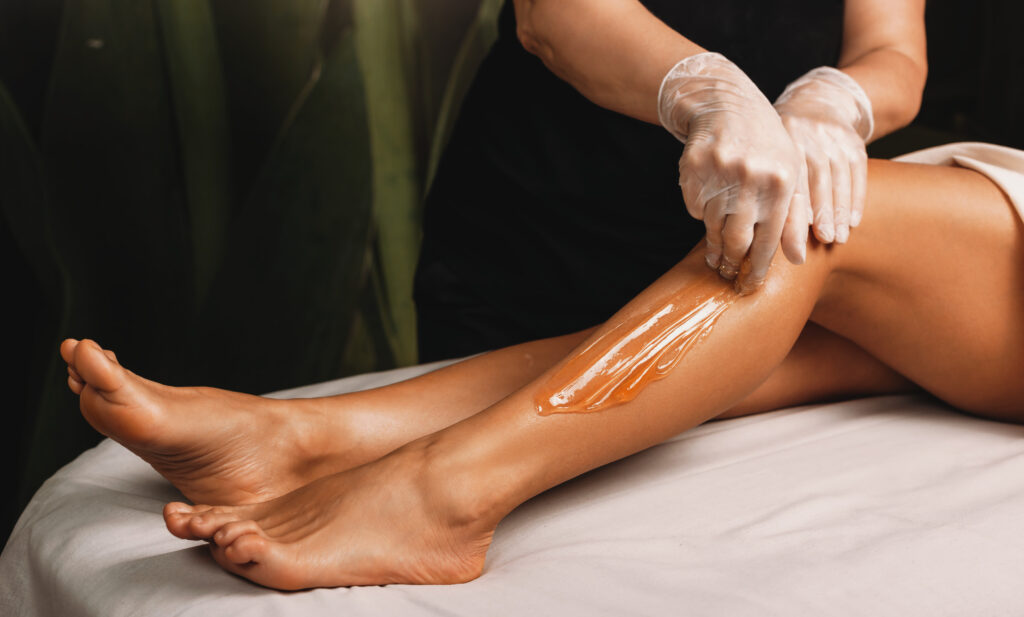
You can also mix and apply the sugar paste for sugaring yourself.
Sugaring uses a sugar paste made of sugar, lemon juice and water. Before treatment, the skin should be clean and dry. The sugar paste is applied to the skin while warm, shaped into a ball. Because the sugar paste only sticks to the hairs and not to the skin, this method is very gentle on the skin. Sugar also has disinfecting and gentle properties when it is applied to the skin.
Long-lasting hair removal with epilation
Epilation also removes hair together with the root and so gives a longer-lasting result. For this, the hairs need to be about 2–5 mm long. For gentle use, the following is recommended:
Trim longer hairs before use
Some epilators can be used wet, so you can use them in the shower.
After a lukewarm shower, the pores are open and epilating may be less painful
Always epilate at a 90-degree angle
Over time, the pain is said to decrease, as the hairs grow back weaker and finer.
Laser as an expensive but gentle method
Permanent hair removal with a laser is the method that is gentlest on the skin. It removes hair for several years. Because the laser destroys the hair roots, this treatment does not damage the skin and is also painless. However, if this method is not carried out properly, it can lead to skin irritation, burns and scarring. That is why laser treatments should always be carried out by experienced dermatologists. However, permanent hair removal can be very expensive.
Hair can also be removed permanently and gently with an IPL device. These devices are based on intense pulsed light technology. Light is used to generate heat, which destroys the hair root. So this is a slightly different method from the laser method. It is important to choose neither too low nor too high an intensity. If necessary, talk to your dermatologist about using an IPL device safely.
Skin care after hair removal
Whichever method you choose, you should take good care of your skin afterwards. So give it mild, moisturising creams.
There is no one-size-fits-all answer to which method is best for your skin. It also depends on your individual skin and your pain tolerance.
If you have open wounds or inflamed areas, you should avoid hair removal. The skin can become inflamed after hair removal. If you then notice inflamed, red and painful lumps (boils) that are still there after about 1 to 2 days, see a dermatologist.
Sources:
- https://www.deineapotheke.at/lifestyle/kosmetik/haarentfernung-die-besten-tipps-6057146v, accessed on 02.05.2023
- https://www.ajoure.de/beauty/pflege/schonende-haarentfernungsmethoden-fuer-empfindliche-haut/, accessed on 02.05.2023
- https://www.glamour.de/artikel/haarentfernung-methoden-rasieren-waxing-epilieren-creme-laser, accessed on 02.05.2023
- https://www.test.de/Haarentfernung-Fuer-immer-weg-1246658-0/, accessed on 02.05.2023
- https://dermatologist.gr/de/service/%CE%B1%CF%80%CE%BF%CF%84%CF%81%CE%AF%CF%87%CF%89%CF%83%CE%B7-%CE%BC%CE%B5-laser/, accessed on 02.05.2023