
Severe allergic reaction – how to recognise anaphylaxis

Most recently, the coronavirus pandemic brought severe allergic reactions (so-called anaphylactic reactions) into the public spotlight. The media reported anaphylactic reactions after Covid-19 vaccinations. Many people with eczema also suffer from allergies. However, these do not always have to be anaphylactic reactions. But what exactly is anaphylaxis, how common is it and how do you recognise these allergic reactions?
Definition
Anaphylaxis is a severe acute allergic reaction that usually occurs quickly after contact with the allergen. Symptoms usually appear within the first hour after contact with the allergen; rarely, it takes up to five hours. The anaphylactic reaction is a potentially life-threatening condition. A suspected anaphylaxis can be investigated further through a detailed medical history, a physical examination, laboratory tests and an allergy test (prick test).
Epidemiology and most common triggers
The frequency is between 0.3 and 5.1%. In children, foods are among the most common triggers of anaphylaxis; in adults, it is insect venoms. New cases have increased in recent years. This applies in particular to anaphylactic reactions triggered by medicines and foods.
Mechanisms
IgE antibodies, which the immune system produces in increased amounts in allergies, are involved in the mechanism by which allergies develop. Mast cells, which contain messenger substances, also play a role. Via IgE antibodies or a direct activation of mast cells, these messenger substances are released. They include histamine, among others. This leads to an inflammatory reaction with widening of the blood vessels. Before such a reaction, the body has been in contact with the allergen at least once. This allows IgE antibodies to form, which trigger the allergic reaction on renewed contact with the allergen. This process is called sensitisation.
Severity grades
Anaphylaxis is classified into four severity grades. In a grade I reaction, there are only symptoms on the skin. Skin symptoms are among the most common symptoms. From grade II, symptoms in the gastrointestinal tract and circulatory problems can occur. Shortness of breath, up to and including an asthma attack, is a common symptom in children. In a grade III reaction, the grade II symptoms get worse. When circulatory and respiratory arrest occurs, this is called grade IV anaphylaxis.
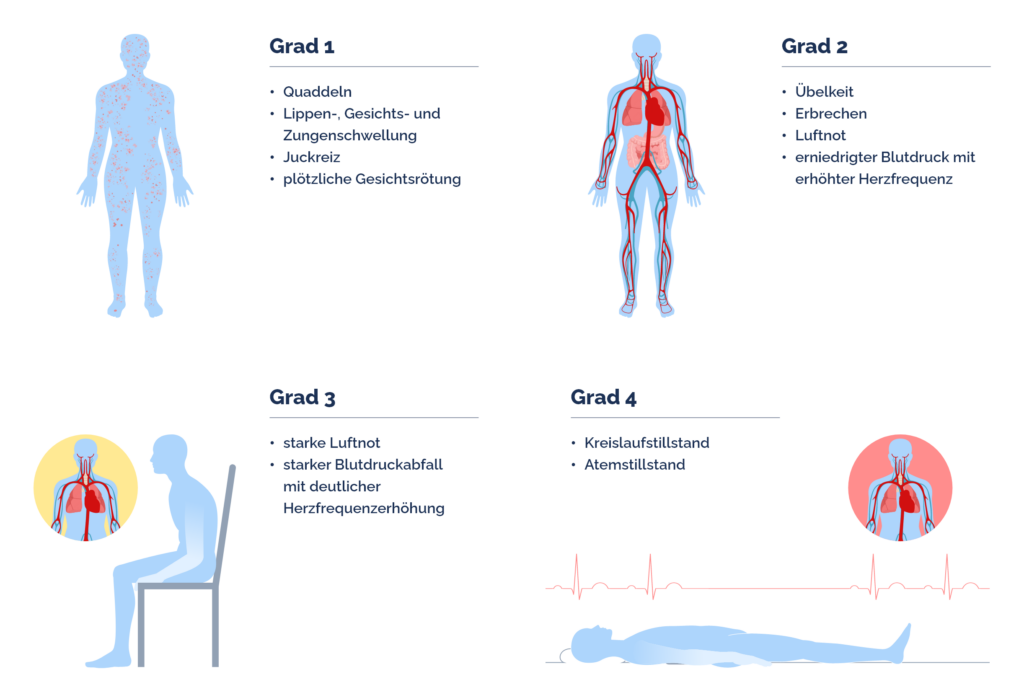
The anaphylactic reaction can remain at any stage or progress to a higher stage. If anaphylaxis is suspected, you must therefore see a doctor.
Risk factors
Risk factors for anaphylactic reactions are:
- older age
- male sex
- specific laboratory values (can be determined by allergy experts if allergic reactions have occurred in the past)
- a previously damaged cardiovascular system
- uncontrolled asthma
- certain pre-existing conditions with an increased number of mast cells
Treatment and prevention
Treatment depends on the severity of the anaphylaxis. The medicines used include antihistamines, cortisone and adrenaline. Adrenaline is used once shortness of breath occurs.
If certain risks are known or an anaphylactic reaction has already occurred, an emergency kit can be prescribed, which those affected should always carry with them. After training in how to use them and information about them, the medicines in the emergency kit (antihistamines, cortisone and an adrenaline pen) can also be used by people without medical training.
Differential diagnoses
Some diseases, such as hives or lung diseases, can resemble the symptoms of an allergy. That is why it is important that a specialist carries out a thorough examination. This can also make sure whether you really should avoid any medicines or substances in the future.
Summary
Anaphylaxis is an acute, potentially life-threatening condition. Seeing a doctor is important not only for acute treatment but also for further investigation. This is because, if anaphylaxis is present, appropriate precautions must be taken.
References
Ring, J., Beyer, K., Biedermann, T., Bircher, A., Fischer, M., Fuchs, T., Heller, A., Hoffmann, F., Huttegger, I., Jakob, T., Klimek, L., Kopp, M. V., Kugler, C., Lange, L., Pfaar, O., Rietschel, E., Rueff, F., Schnadt, S., Seifert, R., Stöcker, B., … Brockow, K. (2021). Guideline (S2k) on acute therapy and management of anaphylaxis: 2021 update: S2k-Guideline of the German Society for Allergology and Clinical Immunology (DGAKI), the Medical Association of German Allergologists (AeDA), the Society of Pediatric Allergology and Environmental Medicine (GPA), the German Academy of Allergology and Environmental Medicine (DAAU), the German Professional Association of Pediatricians (BVKJ), the Society for Neonatology and Pediatric Intensive Care (GNPI), the German Society of Dermatology (DDG), the Austrian Society for Allergology and Immunology (ÖGAI), the Swiss Society for Allergy and Immunology (SGAI), the German Society of Anaesthesiology and Intensive Care Medicine (DGAI), the German Society of Pharmacology (DGP), the German Respiratory Society (DGP), the patient organization German Allergy and Asthma Association (DAAB), the German Working Group of Anaphylaxis Training and Education (AGATE). Allergo journal international, 30(1), 1–25. https://doi.org/10.1007/s40629-020-00158-y
Rossi, C. M., Lenti, M. V., & Di Sabatino, A. (2022). Adult anaphylaxis: A state-of-the-art review. European journal of internal medicine, 100, 5–12. https://doi.org/10.1016/j.ejim.2022.03.003
Worm M. Anaphylaxie-Wer braucht ein Notfallset.DERMAforum Nr. 10 – Oktober 2022.
Worm, M., Vieths, S., & Mahler, V. (2022). An update on anaphylaxis and urticaria. The Journal of allergy and clinical immunology, 150(6), 1265–1278. https://doi.org/10.1016/j.jaci.2022.10.014