
Triggers of eczema in childhood vs. adulthood
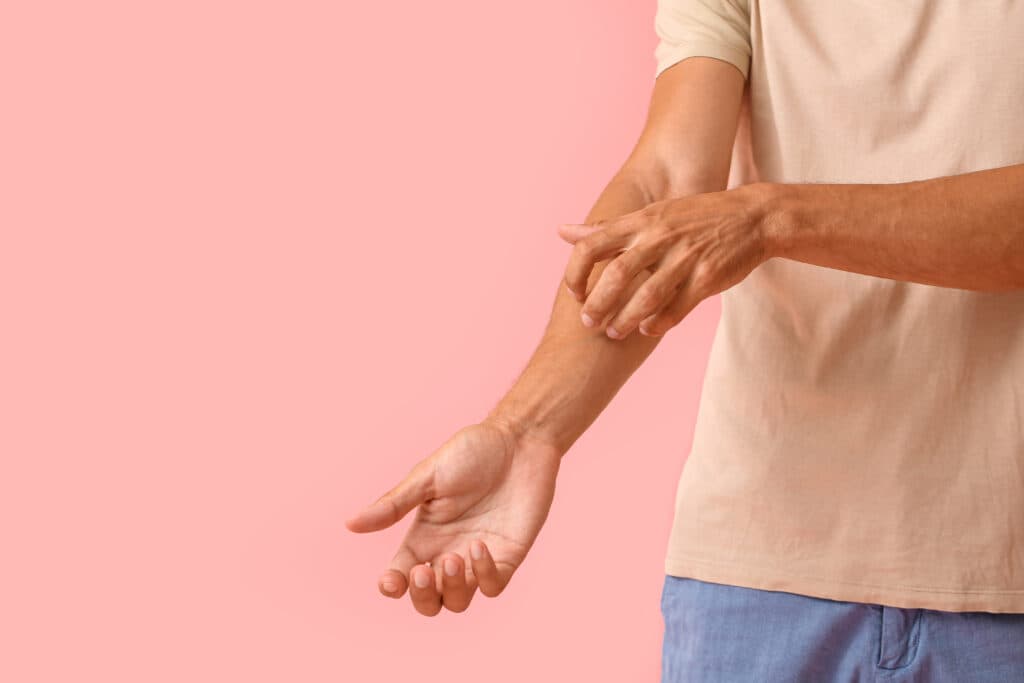
Many people think of eczema as a skin condition of childhood. Sometimes, however, eczema only appears in adulthood. Whether the skin condition starts early or late in life could be linked to different biological factors.
Eczema for the first time in adulthood
Until now, eczema was mainly regarded as a skin condition of childhood. Sometimes the symptoms also persist into adulthood. But the finding that eczema can also break out for the first time in adulthood is still fairly recent.
In a recent study, more than 900 adults were followed for several years. The study found that more than 23 % of the participants only showed eczema symptoms in adulthood. This is therefore called "late onset". If the skin condition starts in childhood, it is accordingly called "early onset".
Risk factors for early vs. late onset
Of course, the causes of developing eczema are always very complex and have many layers. Nevertheless, dermatologist Dr. Maintz in Bonn reports that there are some similarities and differences in the risk factors depending on when in life the condition begins.
| Risk factors early onset | Risk factors late onset |
|---|---|
| Mother has eczema: 33-fold increased risk | |
| Mother has food allergies | increased total IgE* |
| increased total IgE* | more atopic stigmata (physical signs of allergic diseases, e.g. skin rash or conjunctivitis) |
| increased total number of atopic stigmata | active smokers: 4-5-fold increased risk |
| Trends: little physical exercise, passive smoking & living in a small household |
*Increased total IgE means that a specific type of antibody, namely immunoglobulin E (IgE), is present in the blood. IgE is mainly associated with allergic diseases.
Other factors probably also play a role in late onset. Moving to a place with a different climate and different air quality could lead to eczema patches appearing later. If you naturally have dry skin and do not moisturise enough as you get older, this could also lead to eczema.
Fewer comorbidities with late onset
Itching is a typical symptom of eczema and occurs in both forms. However, the symptoms of eczema that starts in adulthood can also differ from early onset. Areas commonly affected in adults are:
- Hands
- Throat and neck
- Face (eyelids, lower face)
- Elbow creases
Almost 88 % of people with eczema who have had the skin condition since childhood also have additional accompanying conditions (comorbidities). With late onset there are fewer – about 73 % have comorbidities. What stands out in particular: people who only develop eczema in adulthood are more likely to also develop allergic rhinitis (frequent sneezing, runny nose caused by allergens). However, the risk of having several other allergic diseases at the same time is about three times lower.
More research needed
In general, still fairly little is known about the course of late-onset eczema. The treatment of both early- and late-onset eczema is, however, the same. The burdens caused by the skin condition improve when the symptoms are treated successfully.
Only a dermatologist can determine whether it really is late-onset eczema. That is why additional tests are often carried out to rule out other diagnoses:
- Allergy test (patch test), which can detect a contact allergy
- Skin biopsy: ruling out other inflammatory skin diseases such as psoriasis.
With the information about the different triggers of early and late onset, researchers and doctors can better understand what the risk of eczema is at different stages of life and how it could be reduced in future through targeted factors.
Sources:
- Storre, ML. Early- versus Late-Onset-Neurodermitis: Welche Faktoren sind assoziiert?. ästhet dermatol kosmetol 15, 21 (2023). https://doi.org/10.1007/s12634-023-2328-z
- Chan AR, Sandhu VK, Drucker AM, Fleming P, Lynde CW. Adult-Onset Atopic Dermatitis: Presentations and Progress. Journal of Cutaneous Medicine and Surgery. 2020;24(3):267-272. doi:10.1177/1203475420911896
- Silverberg J. I. (2019). Adult-Onset Atopic Dermatitis. The journal of allergy and clinical immunology. In practice, 7(1), 28–33. https://doi.org/10.1016/j.jaip.2018.09.029