
Eczema in adults
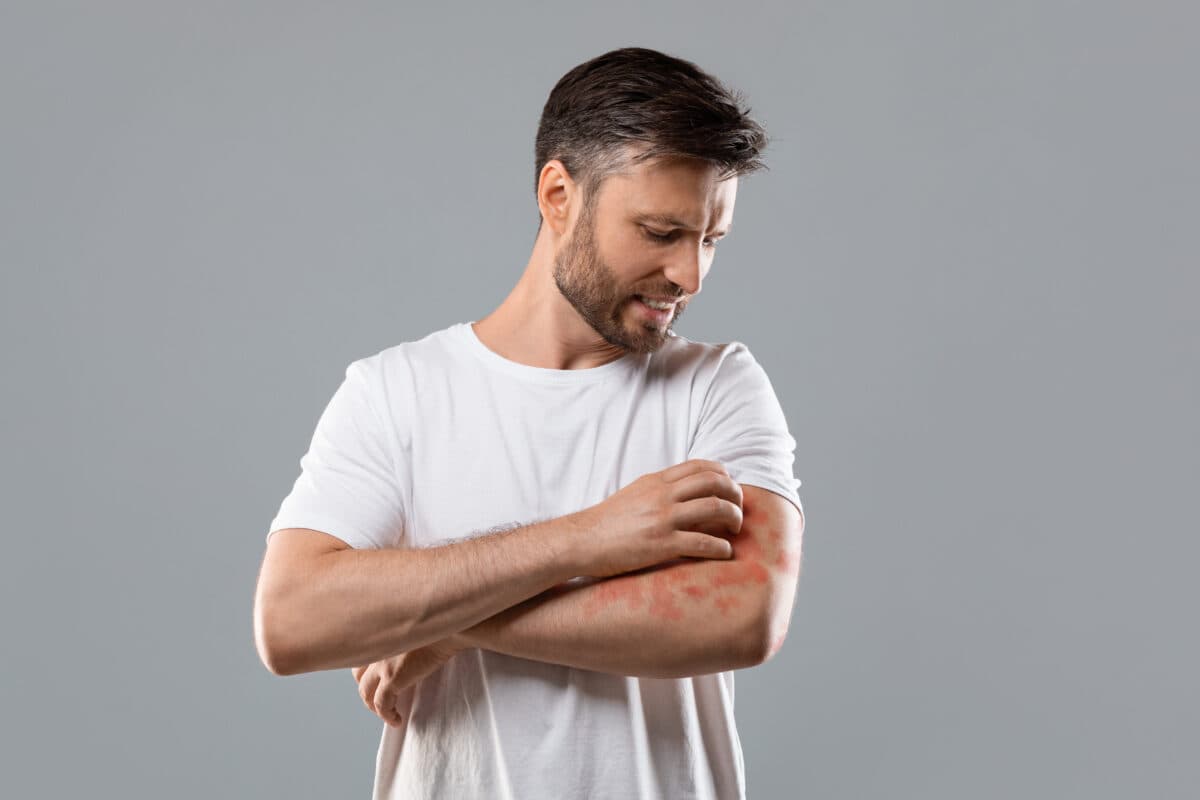
Eczema in young children is a common skin condition. But eczema can also occur in adults. About 2.5 million adults in Germany have it. This means that eczema occurs only rarely in adulthood. However, it can take a severe course. We have put together important information about symptoms, causes and complications for you.
Eczema affects adults' skin differently
In principle, eczema can appear anywhere on the skin. Many symptoms are similar in children and adults. The skin condition comes with extreme itching and can seriously affect quality of life.
However, eczema in adulthood can show up differently than in children. In adults, the skin around the eczema patches is very dry and scaly. Especially after years of symptoms and intense scratching, some areas of skin can become thickened, leathery, lighter or darker.
The crooks of the elbows and the backs of the knees are often affected by eczema in both children and adults. But in adults, it also appears more often on these parts of the body:
- Hands and feet
- Edges of the earlobes
- Scalp
- Face: in adults, the mouth and the area around the eyes in particular are affected.
Some adults had mild eczema as babies and children. When the skin condition comes back in adulthood, the symptoms are often more severe and different. Sometimes people do not recognise their itchy skin as eczema. A visit to a dermatologist then brings clarity about the diagnosis.
When does eczema appear in adulthood?
The causes of eczema are very varied and not yet fully understood. However, eczema has a genetic component. This means that it is inherited. The skin condition does not necessarily have to have shown itself in infancy or childhood, though – it was just “sleeping” in the genes. What triggers such dormant eczema again in adulthood is not yet known.
In most people, eczema that starts in childhood goes away after puberty. Less than 5 % still have eczema 20 years after the first diagnosis. The following risk factors are already known, even if they are not yet well understood:
- Duration: The longer the skin condition has already lasted, the more likely it is to persist in the long term.
- Late onset: Eczema that appears late in childhood increases the risk of persistent symptoms. In contrast, children whose eczema starts early (before the age of 2) have a much lower risk of still struggling with the skin condition in adulthood.
- Sex: Women have a slightly higher risk than men of eczema persisting into adulthood.
Important: Long-lasting eczema does not necessarily take a severe course. Conversely, mild eczema can persist after puberty, and severe eczema can regress spontaneously. Different factors contribute to eczema in adulthood. Taking them into account makes effective and well-tolerated treatment possible.
Spotting complications early
With age, the skin becomes increasingly brittle and dry (you can read more about basic skin care here). This makes it all the more vulnerable to friction and scratch wounds. Certain germs can therefore cause serious complications. The following infections occur more often in adults with eczema:
- Inflammation of the conjunctiva and cornea (atopic keratoconjunctivitis) in the eye
- Fungal infections: Yeasts in particular can trigger eczema in the head and shoulder area. The skin in these areas is red, itchy and flaky (also called head-and-neck dermatitis).
- Bacterial infections, for example with staphylococci, show up as heavily weeping skin with pustules, yellowish crusts and sometimes fever.
- Herpes infections are caused by viruses. They show up as blisters, reddened skin and in some cases fever and swollen lymph nodes.
If these complications appear, you should see a doctor as soon as possible. In rare cases, these complications can have serious consequences.
Sources:
Sources:
https://www.allergieinformationsdienst.de/krankheitsbilder/neurodermitis/verbreitung.html accessed 28.09.2022
https://volksversand.de/ratgeber/gesundheitsblog/gesundheit/haut-haare-naegel/neurodermitis/neurodermitis-bei-erwachsenen-tipps-und-wichtige-informationen accessed 28.09.2022
https://www.aad.org/public/diseases/eczema/adult/can-get accessed 28.09.2022
Kim, J. P., Chao, L. X., Simpson, E. L., & Silverberg, J. I. (2016). Persistence of atopic dermatitis (AD): A systematic review and meta-analysis. Journal of the American Academy of Dermatology, 75(4), 681–687.e11. https://doi.org/10.1016/j.jaad.2016.05.028